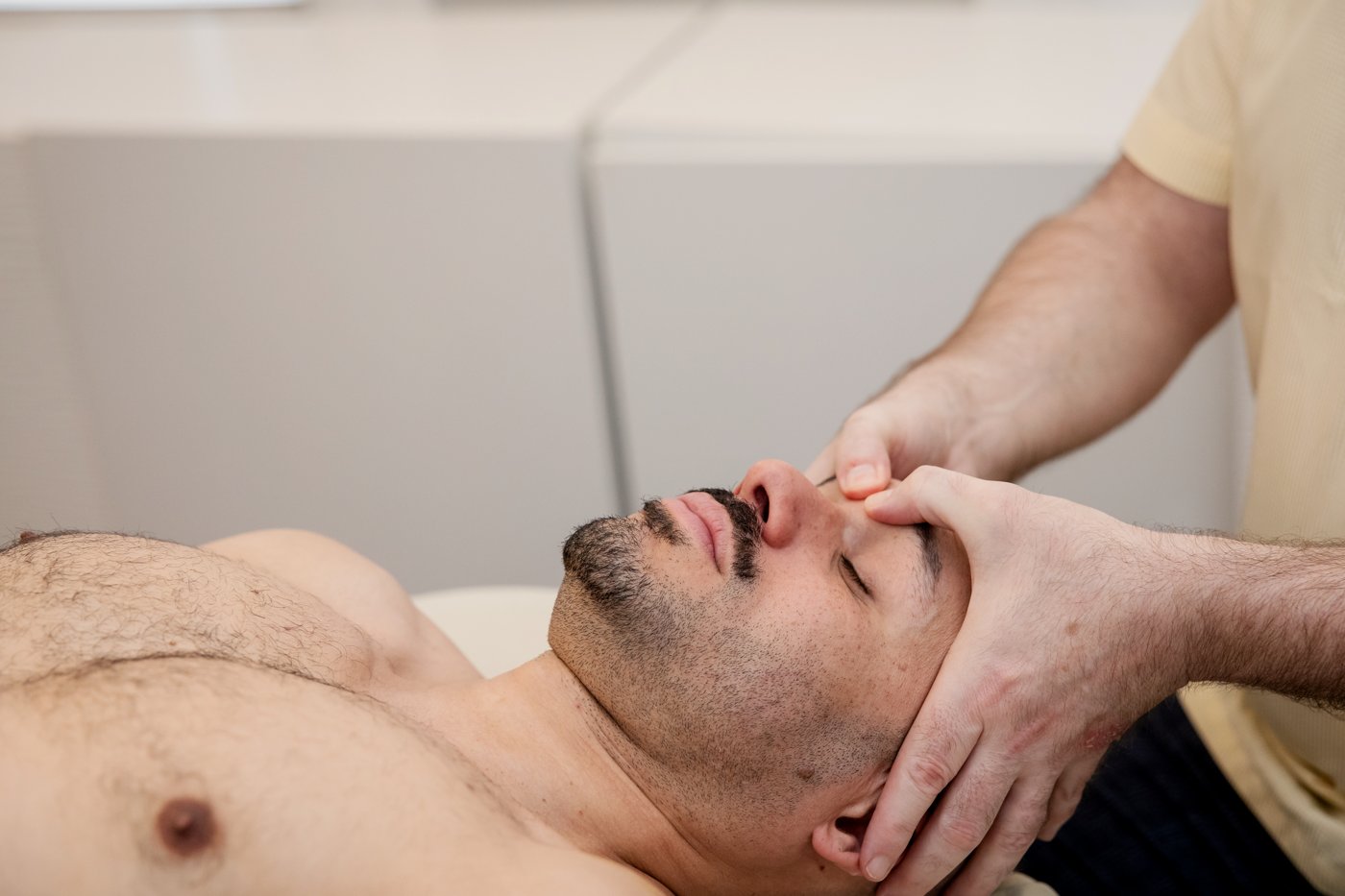
The tight jaw. The shoulders up around your ears. The knot in your stomach that never fully goes away. Anxiety doesn't just live in your head; it sets up camp in your body. Over time, chronic stress and anxiety create physical patterns that become self-reinforcing: tension leads to pain, pain increases stress, and the cycle deepens. Your nervous system gets stuck in a state of high alert, and your muscles follow.
Most people who come to me for anxiety-related tension have tried to think their way out of it. Meditation, breathing exercises, talk therapy. Those are valuable tools, but they don't always reach the physical patterns that have already taken hold. When your trapezius has been clenched for months, it needs hands-on intervention to let go.
How I Work With Anxiety-Related Tension
The physical signature of anxiety is remarkably consistent. It concentrates in the jaw, the neck and shoulders, the upper back, the diaphragm, and the hip flexors. These aren't random areas. They're the muscles your body recruits when it's bracing for something (Travell & Simons, 1999). My job is to systematically release that holding pattern and give your nervous system room to downshift.
I use neuromuscular therapy and myofascial release to address the specific tension areas, combined with pacing and pressure that support your nervous system rather than overwhelm it (Moyer et al., 2004). The work is deliberate but never aggressive. For someone whose body is already on edge, aggressive bodywork only confirms what the nervous system already believes—that it needs to stay guarded.
We talk at the beginning of each session about where you're carrying the most tension that day, what's been happening in your life, and how your body has been responding. That conversation matters because stress-related tension is connected to everything else going on. The more I understand the full picture, the more effective the work.
Clients dealing with anxiety often describe a particular quality of relief after a session. Not physical looseness alone, but a sense of settling. Like their body finally exhaled. That's the nervous system responding to targeted release (Field, 2014). Over time, with consistent work, those patterns of chronic tension begin to lose their grip. You can recover a sense of ease in your own body: the kind that lets you actually rest, move freely, and feel like yourself again.
What a Course of Sessions Looks Like
One session will help. It won't reset a nervous system that's been on high alert for months or years. For most clients working through anxiety-driven tension, the work makes its biggest difference over the first four to six sessions, spaced out every one to two weeks. The first session tells us where your body is holding the most — usually the jaw, the suboccipitals at the base of the skull, and the middle trapezius between the shoulder blades. The second session often goes deeper because the tissue is ready to receive it.
By the third or fourth visit, most clients start to notice things outside the session — sleeping more soundly, a quieter chest, fewer shoulder flare-ups after a stressful day. That's the body learning it doesn't have to hold the pattern anymore. From there, a maintenance rhythm of every three to four weeks is usually enough to keep the ground you've reclaimed.
A few signs the work is doing what it should: you feel calmer for two or three days afterward, not just the night of. Your sleep improves in quality, not just length. You notice yourself breathing deeper without being told to. These are the markers to watch for. If none of them show up after a few sessions, tell me. It means we need to adjust the approach.
References & Further Reading
- Travell JG, Simons DG. (1999). Myofascial Pain and Dysfunction: The Trigger Point Manual. Volume 1: Upper Half of Body, 2nd ed. Williams & Wilkins.
- Moyer CA, Rounds J, Hannum JW. (2004). A meta-analysis of massage therapy research. Psychological Bulletin, 130(1): 3–18.
- Field T. (2014). Massage therapy research review. Complementary Therapies in Clinical Practice, 20(4): 224–229.