You've had this pain so long you've stopped talking about it. You've adjusted your life around it—changed how you sit, what you carry, which sleeping position works best. Maybe it flares occasionally, maybe it's a constant dull ache that just colors everything. Either way, you've made peace with it being part of your life.
The problem is that chronic pain doesn’t stay localized. Your body finds workarounds. It creates compensation patterns. If your lower back is chronically tight, your shoulders tense to protect it. If your neck is rigid from desk work, your upper back takes the strain. These patterns reinforce each other, and before long, you’re in chronic pain across multiple areas. Janda (1987a; 1987b) catalogued the upper-and-lower-crossed compensation pattern decades ago, and it’s still the most useful framework I’ve found for thinking about how pain in one region builds restrictions everywhere else.
Finding What’s Actually Causing the Pain
Whether your pain is recent or you’ve carried it for years, the root cause is usually a specific muscular pattern or structural limitation that hasn’t been properly identified yet. Desk work, stress patterns, old injuries, postural habits — they all create predictable tightness and compensation. My job is to find what’s actually driving the pain, not only the spot that's sore.
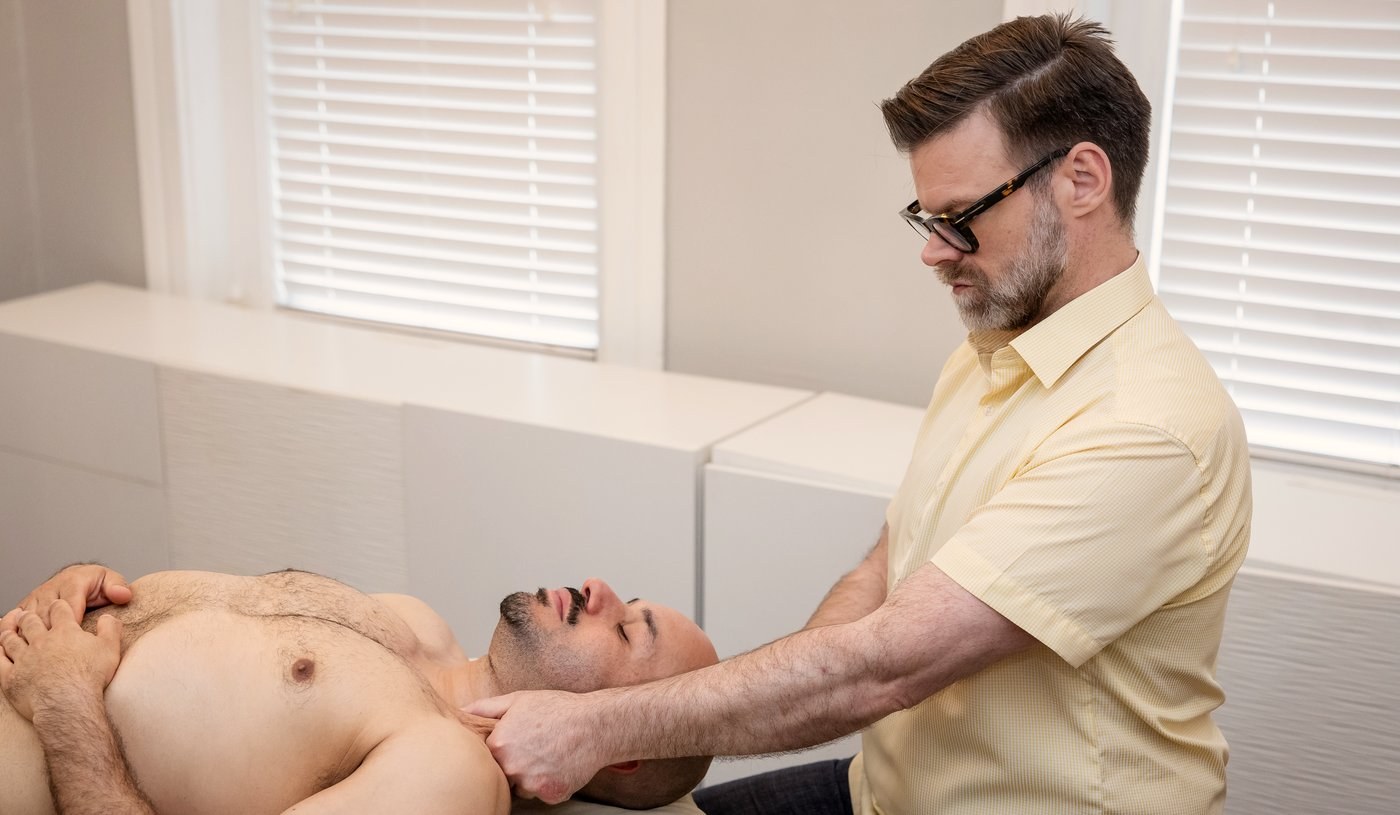
I spend time understanding your history, how the pain moves, what makes it better or worse. From there, I systematically address the muscles and tissue patterns creating the problem. Sometimes the pain you feel in your neck originated in your chest. Sometimes your lower back pain is rooted in hip tightness. Trigger-point work has been mapping these referred-pain patterns in the upper body for decades (Travell & Simons, 1999), and the practical takeaway holds: the body is interconnected, and real recovery requires addressing the whole system.
Most clients find that as these patterns release, they can reclaim the movement, posture, and lifestyle they thought was gone. You can sit without thinking about pain, sleep through the night, move with confidence again. That’s what sustainable recovery looks like.
Patterns I See Most Often
After two decades, the specific pain patterns in this region are remarkably predictable. Desk workers come in with forward-head posture, locked upper traps, and a specific pattern of tension through the levator scapulae and rhomboids. The pain shows up between the shoulder blades or as a dull headache at the base of the skull. Scapular muscle recruitment becomes patterned around the impingement — the lower trapezius and serratus anterior fire late, the upper trap fires early, and the same overworked muscles keep compensating (Cools et al., 2003). The answer isn’t working the shoulders harder — it’s releasing the chest and front of the neck that pull the head forward in the first place, then rebuilding the underbuilt scapular stabilizers (Page, Frank & Lardner, 2010).
Parents and caregivers carry a different pattern. Years of picking up kids, carrying bags on one side, and holding tension through the low back and hips creates asymmetric strain that runs up into the shoulder. One side almost always carries more. Sleeping on a couch or with a kid in the bed feeds it. Work here has to account for the load pattern, not only the sorest spot.
Clients with old injuries (a car accident, a bad fall, a shoulder surgery years back) often carry protective patterns long after the original injury has recovered. The body learned to guard the area and never let go. Those patterns respond well to slow, deliberate work that signals to the nervous system it’s safe to release. We rebuild range of motion carefully, and most clients are surprised how much they’d been bracing without knowing it.
Related: Posterior chain imbalance · Tech neck · The posterior chain problem · Biceps tendonitis
References & Further Reading
- Janda V. (1987a). Muscles and motor control in cervicogenic disorders: Assessment and management. In: Grant R, ed. Physical Therapy of the Cervical and Thoracic Spine. New York: Churchill Livingstone.
- Janda V. (1987b). Muscle weakness and inhibition (pseudoparesis) in back pain syndromes. In: Grieve GP, ed. Modern Manual Therapy of the Vertebral Column. Edinburgh: Churchill Livingstone.
- Travell JG, Simons DG. (1999). Myofascial Pain and Dysfunction: The Trigger Point Manual. Volume 1: Upper Half of Body, 2nd ed. Baltimore: Williams & Wilkins.
- Cools AM, Witvrouw EE, Declercq GA, Danneels LA, Cambier DC. (2003). Scapular muscle recruitment patterns: trapezius muscle latency with and without impingement symptoms. American Journal of Sports Medicine, 31(4): 542–549.
- Page P, Frank C, Lardner R. (2010). Assessment and Treatment of Muscular Imbalance: The Janda Approach. Champaign, IL: Human Kinetics.