You've probably tried everything. Pain relievers, preventatives, lifestyle changes, dietary shifts. And while medication can help manage the acute pain, it doesn't address the underlying muscular and postural patterns that are triggering the migraines in the first place. You're treating the symptom, not the cause.
Here’s what I’ve observed over 20 years: migraines almost always have a muscular component. The tension in your neck, shoulders, and the base of your skull doesn’t just cause headaches. It can trigger full-blown migraines (Bogduk, 2014; Watson & Drummond, 2012). When those muscles stay tight, the nerves get compressed, blood flow changes, and your body responds with pain. Trigger points in the suboccipital muscles, sternocleidomastoid, and upper trapezius refer pain to the head and face, and these patterns respond well to direct soft tissue work (Travell & Simons, 1999).
How I Approach Migraines
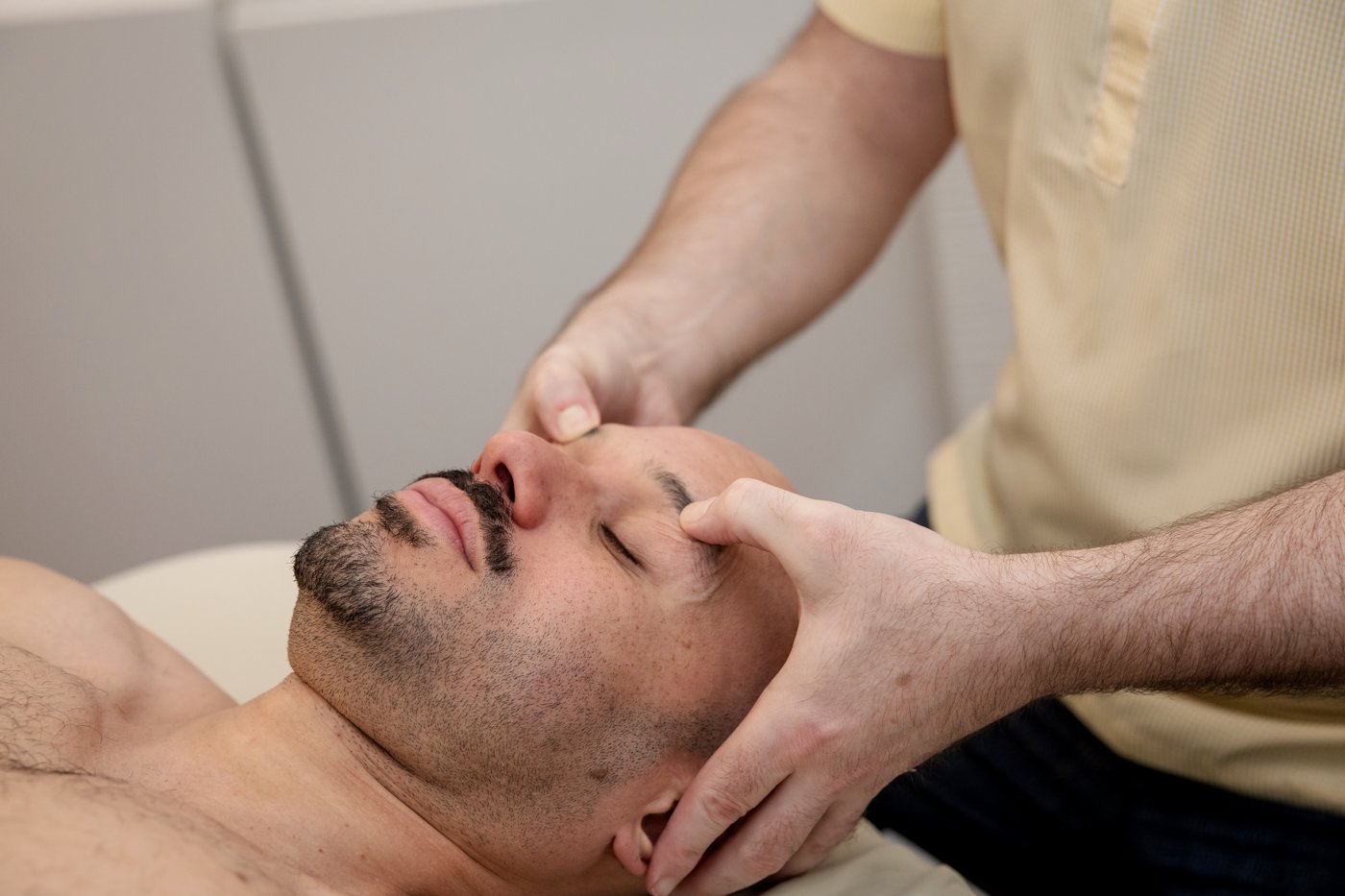
I start with the neck and shoulders — the base of your skull, behind your ears, the muscles that run down the sides of your neck. Then I spend real time on the face: the jaw, the temples, the forehead, the muscles around the eyes. It’s intense work. Most people aren’t used to having those areas addressed directly. But the payoff is worth it. Clients respond to this when nothing else has really helped.
I’m also paying attention to your patterns. Where does the pain start before it becomes a full migraine? What precedes it — stress, screen time, jaw clenching, a bad night of sleep? Knowing your pattern changes what we prioritize and helps you recognize the early signals.
Most clients who commit to regular sessions notice a real decrease in how often migraines hit and how intense they are. Some find they can reduce medication, or need it less often. It’s not magic. It’s addressing a mechanical problem that responds to direct, skilled work.
Patterns I See
Tension-driven migraines — the ones that start at the base of the skull or in the shoulders and climb — tend to respond the fastest. Most clients in this category notice changes within three or four sessions. Postural migraines from long hours at a screen respond well once we release the front of the neck and chest that pull the head forward (Watson & Drummond, 2012). Stress-pattern migraines involve the jaw and the breathing — those take longer because we’re working with nervous-system habits, not just tight tissue. A systematic review found that trigger point manual therapy significantly reduced migraine frequency and intensity, particularly when applied regularly (Falsiroli Maistrello et al., 2018).
Hormonal and dietary migraines are a different category. Massage helps with the muscular tension that makes them worse, but it’s not addressing the root trigger, and I’ll tell you that directly.
References & Further Reading
- Bogduk N. (2014). The neck and headaches. Neurologic Clinics, 32(2): 471–487.
- Watson DH, Drummond PD. (2012). Head pain referral during examination of the neck in migraine and tension-type headache. Headache, 52(8): 1226–1235.
- Travell JG, Simons DG. (1999). Myofascial Pain and Dysfunction: The Trigger Point Manual. Volume 1: Upper Half of Body. Baltimore: Williams & Wilkins.
- Janda V. (1987). Muscle weakness and inhibition (pseudoparesis) in back pain syndromes. In: Grieve GP, ed. Modern Manual Therapy of the Vertebral Column. Edinburgh: Churchill Livingstone.
- Falsiroli Maistrello L, Geri T, Gianola S, Zaninetti M, Testa M. (2018). Effectiveness of trigger point manual treatment on the frequency, intensity, and duration of attacks in primary headaches: A systematic review and meta-analysis of randomized controlled trials. Frontiers in Neurology, 9:254.