You probably haven’t heard of the piriformis muscle. It’s a small, deep muscle in your hip that sits right on top of the sciatic nerve. And when it gets tight, it can create pain that feels almost exactly like sciatica — a sharp, burning sensation down your leg, weakness, numbness. People spend months or years treating what they think is a sciatic nerve problem, when the real culprit is their piriformis muscle.
The piriformis is easy to overlook because it’s small and deep. It doesn’t show up on most imaging, and the symptoms mimic lumbar sciatica almost perfectly. The anatomical relationship makes it worse: the sciatic nerve runs directly underneath the piriformis, and in roughly one in six people the nerve actually pierces or splits around the muscle (Beaton & Anson, 1937; Smoll, 2010). But the piriformis is actually one of the most responsive muscles to treatment when the work reaches it directly. That’s where targeted massage makes the difference.
Why Piriformis Syndrome Gets Misdiagnosed
The piriformis muscle is responsible for external rotation of your hip. When it gets tight from sitting, repetitive movement, or even stress and posture, it can squeeze the sciatic nerve running beneath it — producing the shooting or burning pattern down the leg that gets labeled sciatica (Travell & Simons, 1992). The result feels like classic nerve-root sciatica, but the treatment path is completely different.
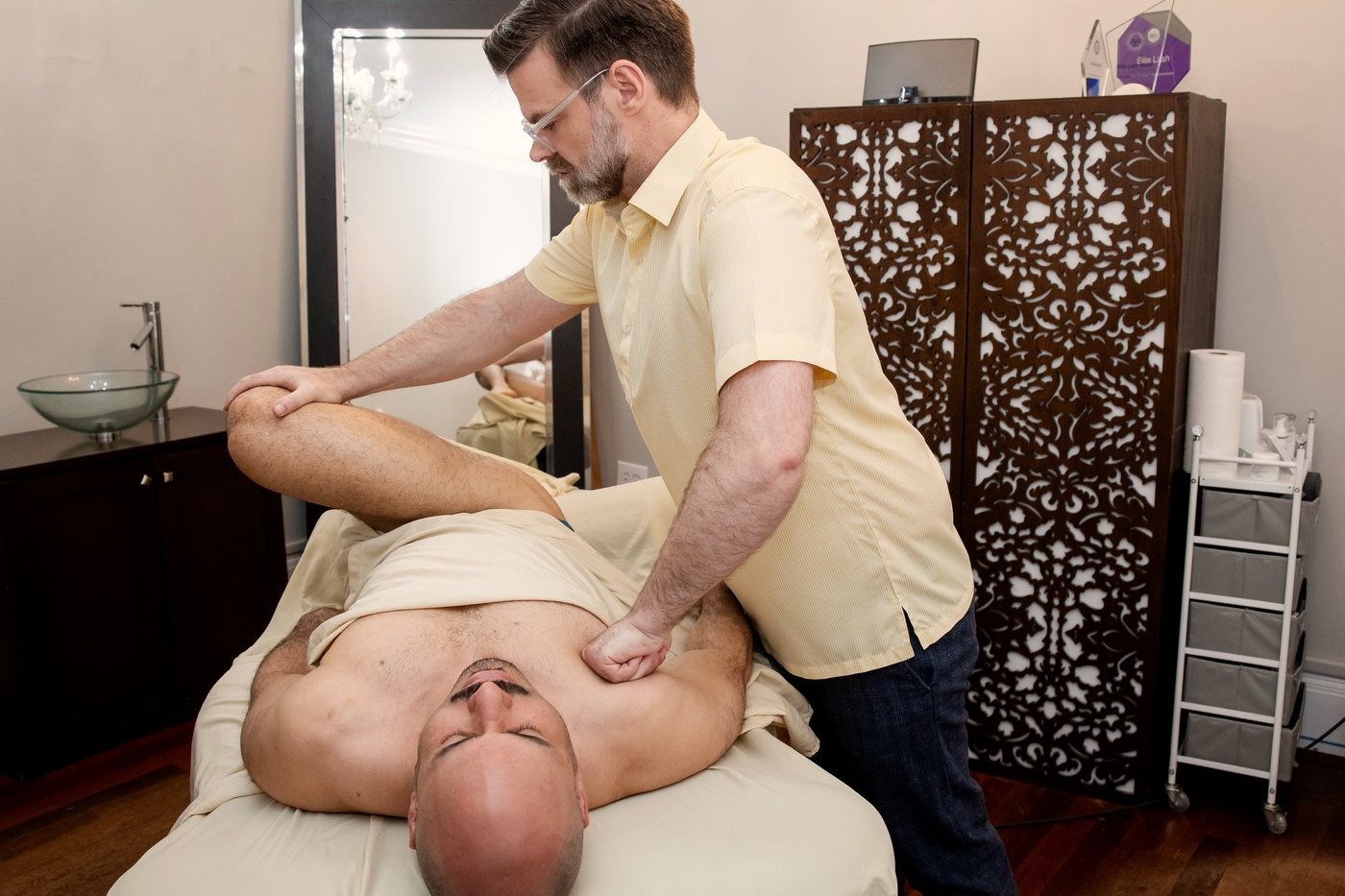
I assess specifically for piriformis involvement by testing your hip rotation and pressure on the muscle itself. If that’s where the problem is, I release it through deep, targeted pressure and myofascial techniques. The relief is often immediate. Most clients notice significant improvement within 2–3 sessions.
The key is consistent work to prevent it from tightening again. The piriformis is usually tight because it’s compensating for weak gluteus medius and gluteus maximus — once those carry their share, the piriformis stops being recruited as the primary hip stabilizer (Tonley et al., 2010). I’ll teach you about the positions and movements that created the problem in the first place, so you can reclaim full hip mobility and keep the nerve uncompressed.
Simple Ways to Tell If It’s Piriformis
Most of the people who come in convinced they have sciatica actually have a piriformis issue. There’s a test you can do at home that points toward one or the other. Sit in a chair with your feet flat on the floor. Cross the affected leg so your ankle rests on the opposite knee, then gently lean forward. If you feel a deep, sharp stretch or sudden reproduction of your pain in the buttock of the crossed leg, the piriformis is almost certainly involved. If leaning forward mostly pulls in your low back instead, it’s more likely lumbar. This isn’t a diagnosis, but it tells us where to start.
Other signs point toward piriformis: the pain is worse after sitting for long stretches, it gets aggravated by driving, and it often improves a bit when you walk. Classic lumbar-source sciatica tends to be the opposite. Walking makes it worse, sitting provides relief. Piriformis pain is also usually one-sided and doesn’t extend past the knee as often. These aren’t hard rules, but they’re useful signals.
Between sessions, the most useful things you can do are simple. Avoid crossing the affected leg while sitting. Use a lumbar support or a cushion that keeps your hips slightly above your knees. Short walks beat long sits. Skip the foam rolling of your buttock. It almost always makes piriformis worse, not better. Gentle hip-opening floor work is fine if your PT has cleared it. Come in and we’ll work out what helps and what doesn’t for your specific pattern. The pattern Janda (1987b) called lower crossed syndrome (tight hip flexors and lumbar erectors paired with inhibited glutes) sits underneath most piriformis-pattern pain, which is why the strengthening side matters as much as the release work.
Related: Sciatica · Why your sciatica keeps coming back · Posterior chain imbalance · The posterior chain problem
References & Further Reading
- Beaton LE, Anson BJ. (1937). The relation of the sciatic nerve and of its subdivisions to the piriformis muscle. Anatomical Record, 70(1): 1–5.
- Smoll NR. (2010). Variations of the piriformis and sciatic nerve with clinical consequence: a review. Clinical Anatomy, 23(1): 8–17.
- Travell JG, Simons DG. (1992). Myofascial Pain and Dysfunction: The Trigger Point Manual. Volume 2: The Lower Extremities. Baltimore: Williams & Wilkins.
- Tonley JC, Yun SM, Kochevar RJ, Dye JA, Schroeder S, Tillman MD. (2010). Treatment of an individual with piriformis syndrome focusing on hip muscle strengthening and movement reeducation: a case report. Journal of Orthopaedic & Sports Physical Therapy, 40(2): 103–111.
- Janda V. (1987b). Muscle weakness and inhibition (pseudoparesis) in back pain syndromes. In: Grieve GP, ed. Modern Manual Therapy of the Vertebral Column. Edinburgh: Churchill Livingstone.