That dull, persistent pain around or behind your kneecap. The way it flares when you're climbing stairs or pushing off hard on a run. The frustration of seeing your mileage drop or having to take time off from what you love. I've worked with dozens of runners dealing with patellofemoral pain syndrome, what most people call runner's knee, and I understand how discouraging it feels when the obvious answer (rest) isn't enough to actually resolve it.
Here's what most runners don't realize: runner's knee usually isn't the knee's fault. The pain is a signal that something upstream is creating too much stress on the patellofemoral joint. Weak glute medius muscles force your knee to track inward under load(Powers, 2010). The TFL and glute max over-recruit to compensate, transmitting load through the IT band and compressing tissue at the lateral knee. Quad dominance without sufficient posterior chain strength creates imbalance. Your knee is just the loudest messenger about dysfunction that started in your hip and glutes.
Why Runner's Knee Persists Without the Right Approach
Most runners ice the knee, maybe take a week off, and then return to running the same way they trained before. The pain comes back because the underlying problem—weak hip abductors and external rotators, tight lateral thigh, quad-dominant movement pattern—was never addressed. You can't run your way out of it, and rest alone doesn't solve it.
My work focuses on the posterior chain. Runners with runner's knee almost always have weak glute medius muscles and tight, overworked quadriceps. The glute med is responsible for keeping your pelvis stable and your knee properly tracked as you land and push off(Reiman, Bolgla & Loudon, 2012). When it's underfunctioning, your knee caves inward slightly with each step. That tracking issue is the primary driver of patellofemoral pain. Add the TFL and glute max compensating, pulling on the IT band and compressing tissue at the lateral knee, and you have a problem that massage alone won't solve, but that soft tissue work can meaningfully improve.
How I Work With Runner's Knee
Treatment starts with assessment. I look at your hip strength, your squat pattern, how your knee moves under load, and I palpate the tissues around your knee and hip. I'm looking for the specific restrictions. Is it TFL and glute max overload pulling on the IT band? Is your vastus medialis oblique (VMO) weak and underfiring? Is your glute med shut down from hip tightness or neural inhibition?
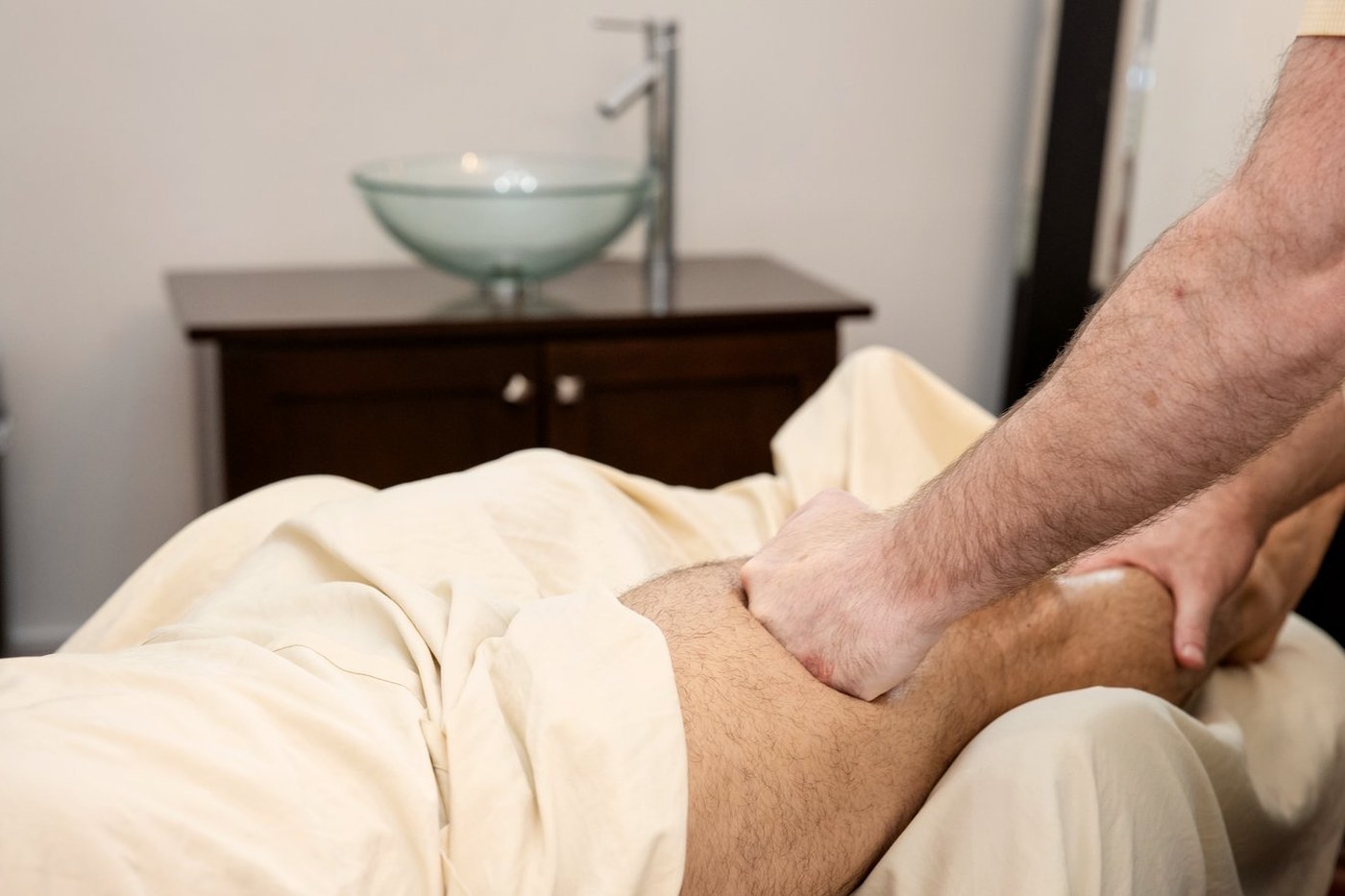
From there, I release the muscles that are overworking—primarily your TFL, glute max, vastus lateralis, and rectus femoris—using neuromuscular and myofascial techniques. The IT band is fascia, not a muscle; the work that helps it is freeing what pulls on it. I also assess and address hip flexor tightness, which indirectly weakens your glutes by changing your pelvic position(Travell & Simons, 1992). Most runners see notable improvement within 3-5 sessions when they pair massage with home strengthening work.
The massage work is necessary but not sufficient. Between sessions, you need to strengthen your glute medius with exercises like clamshells, side-lying leg lifts, and lateral band walks. These aren't glamorous exercises, but they are the primary tool for preventing runner's knee from coming back.
What to Do Between Sessions—Home Exercise Strategy
After your first session, you'll get specific exercises to address your glute weakness. Do them consistently. Glute med strengthening 4-5 times a week matters more than a high volume of running. Once you feel better, don't drop the exercises. That's how it comes back. Make these strengthening movements part of your running routine permanently.
While running, keep mileage moderate and avoid sudden jumps in volume. If pain is mild during easy-paced runs, continuing to run is fine. If it's sharp or gets worse, take 3-5 days off and focus on soft tissue work and strengthening. Hills and speed work should wait until you're pain-free for at least two weeks. Ice after runs if there's any swelling or inflammation. Recovery matters. Sleep, hydration, and nutrition all feed into recovery.
Runner's knee is one of the most preventable running injuries if you address the root cause instead of just treating the symptom. Your knee is built to handle the demands of running. It's built to recover and rebuild. Sometimes it just needs the right intervention, releasing tight tissue and rebuilding weak muscle, to help you get back to running strong.
References & Further Reading
- Powers CM. (2010). The influence of abnormal hip mechanics on knee injury: A biomechanical perspective. Journal of Orthopaedic & Sports Physical Therapy, 40(2): 42–51.
- Reiman MP, Bolgla LA, Loudon JK. (2012). A literature review of studies evaluating gluteus maximus and gluteus medius activation during rehabilitation exercises. Physiotherapy Theory and Practice, 28(4): 257–268.
- Travell JG, Simons DG. (1992). Myofascial Pain and Dysfunction: Volume 2: The Lower Extremities. Baltimore: Williams & Wilkins.
- Boling MC, Padua DA, Marshall SW, Guskiewicz K, Pyne S, Beutler A. (2009). A prospective investigation of biomechanical risk factors for patellofemoral pain syndrome: The Joint Undertaking to Monitor and Prevent ACL Injury (JUMP-ACL) cohort. American Journal of Sports Medicine, 37(11): 2108–2116.