That sharp, burning pain down your leg. The way you shift in your seat every few minutes looking for relief. The frustration of not being able to sit comfortably, walk without thinking about it, or sleep without waking up in the middle of the night. I’ve worked with hundreds of clients living with sciatica, and I know how much it changes your day.
Here’s what most people don’t realize: the sciatic nerve is getting compressed or irritated somewhere — usually in the lower back or deep in the hip. The pain you feel down your leg is just the messenger. If you’ve been treating the symptom without addressing what’s actually causing the compression, you’re fighting an uphill battle.
How I Work With Sciatica
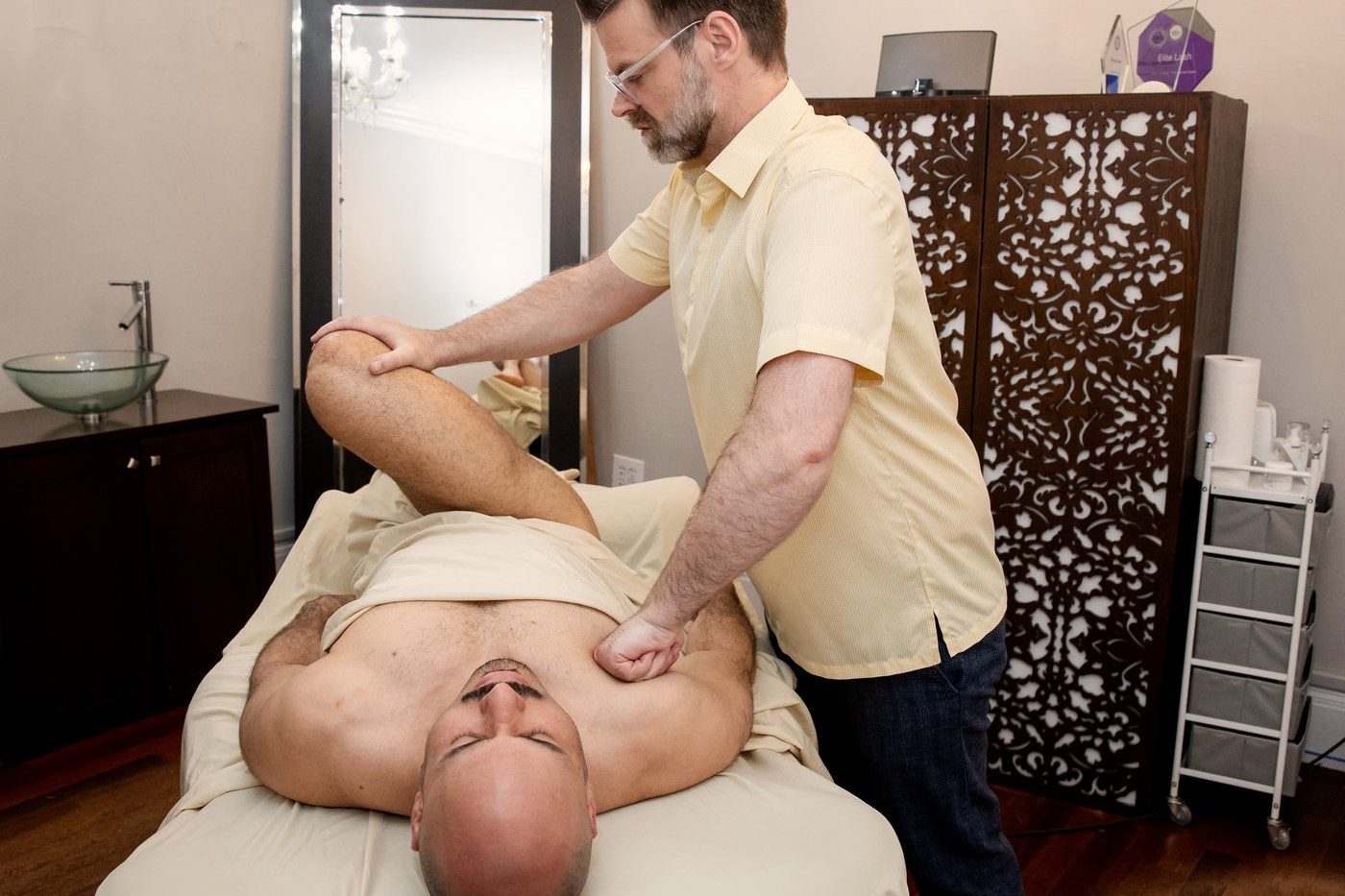
In my practice, I focus on finding where that nerve is actually being squeezed. Often it’s the piriformis muscle in your hip — that deep muscle that sits right on top of the nerve. Sometimes it’s a structural issue in the lumbar spine itself. Either way, I use neuromuscular therapy (skilled muscle release) and myofascial release (sustained pressure on connective tissue) to release the tension that’s creating the compression.
Your first session starts with assessment. I listen to your history, understand where and how the pain moves, and then work to identify the specific muscles or tissue patterns creating the problem. From there, I apply targeted pressure and soft tissue manipulation to restore mobility and release the nerve.
Most clients notice a significant difference within the first few sessions. You’ll start to reclaim your ability to sit, walk, and sleep without constant pain. The goal isn’t to manage the pain. It’s to recover full function.
Sciatica typically responds well to this approach because we’re addressing root cause, not just symptoms. Whether your issue is recent or you’ve been living with it for years, your body wants to recover. Sometimes it just needs the right intervention.
Sciatica vs. Piriformis Syndrome
Many clients come in saying they have sciatica when what they actually have is piriformis syndrome. Or they have both and don’t know the difference. Sciatica is the symptom: pain along the sciatic nerve. Piriformis syndrome is one of the most common causes of that symptom. The piriformis muscle sits deep in the hip, and the sciatic nerve runs directly underneath it. And in about one in six people, the nerve actually passes through or around it (Beaton & Anson, 1937; Smoll, 2010). When the piriformis gets chronically tight, it compresses the nerve and produces that shooting or burning pain down the leg (Travell & Simons, 1992).
In my experience, piriformis involvement is a factor in most of the sciatica cases I treat. The distinction matters because the work is different. Lumbar-origin sciatica requires releasing the muscles along the spine and the deep low back around the nerve root. Piriformis-origin sciatica requires deep, targeted work into the deep hip rotators. Often it’s both. Either way, the assessment tells me where to focus.
Why Sciatica Keeps Coming Back
If your sciatica keeps returning, you’re not imagining things. And you’re not doing anything wrong. The pattern recurs because most treatments release the tight muscle without addressing why it’s tight in the first place.
The piriformis is usually tight because it’s compensating for weak glutes. When the large glute muscle and the muscle on the side of the hip (glute med) aren’t carrying their share of hip stabilization — which is almost universal in people who sit all day — the piriformis picks up the slack (Tonley et al., 2010). You stretch it, it loosens, the glutes still aren’t doing their job, and the piriformis tightens right back up. Same story with the low back: weak glutes force the lumbar muscles to overwork, and they compress the nerve roots. The pattern matches what Janda (1987b) described as lower crossed syndrome — tight hip flexors and lumbar erectors paired with inhibited glutes and deep abdominals.
This is why the second half of sciatica treatment is strengthening. Glute bridges, clamshells, single-leg work — the exercises that rebuild the posterior chain so your piriformis and low back can finally stand down (Page, Frank & Lardner, 2010). I write about this cycle in more detail here →
During an Acute Flare — What Actually Helps
Acute sciatic flares are miserable. If you’re in one right now, a few things genuinely help and a few things make it worse. Ice the lower back or glute for twenty minutes at a time, a few times a day, during the first 48–72 hours. It calms the nerve irritation. After that window, switch to gentle heat if it feels better. Avoid heavy stretching during a flare. Hamstring stretches in particular, which feel like they should help, usually just tug on an already-inflamed nerve.
For sleep, side-lying with a pillow between the knees tends to be the most tolerable position. If that doesn’t work, try on your back with a pillow or two under the knees. Flat on your stomach is almost always the worst choice during a flare because it extends the low back and compresses the nerve root. For sitting, a firm chair is better than a soft couch, and a rolled towel or small cushion in the small of your back takes pressure off the lumbar spine.
Most clients come in during an acute flare because the pain is the loudest then. That’s fine. The work at that stage is gentler and more neurological than muscular, but it still shifts things. If you’re in the first few days of a severe flare with new numbness, loss of bladder or bowel control, or weakness that’s getting rapidly worse, call your doctor before booking with me. Those are signs of something that needs medical evaluation first. Short of that, we can usually start relieving pressure within the first session.
Related: Why your sciatica keeps coming back · Piriformis syndrome · Posterior chain imbalance · The posterior chain problem · Neck, back & shoulder pain
References & Further Reading
- Beaton LE, Anson BJ. (1937). The relation of the sciatic nerve and of its subdivisions to the piriformis muscle. Anatomical Record, 70(1): 1–5.
- Smoll NR. (2010). Variations of the piriformis and sciatic nerve with clinical consequence: a review. Clinical Anatomy, 23(1): 8–17.
- Travell JG, Simons DG. (1992). Myofascial Pain and Dysfunction: The Trigger Point Manual. Volume 2: The Lower Extremities. Baltimore: Williams & Wilkins.
- Janda V. (1987b). Muscle weakness and inhibition (pseudoparesis) in back pain syndromes. In: Grieve GP, ed. Modern Manual Therapy of the Vertebral Column. Edinburgh: Churchill Livingstone.
- Tonley JC, Yun SM, Kochevar RJ, Dye JA, Schroeder S, Tillman MD. (2010). Treatment of an individual with piriformis syndrome focusing on hip muscle strengthening and movement reeducation: a case report. Journal of Orthopaedic & Sports Physical Therapy, 40(2): 103–111.
- Page P, Frank C, Lardner R. (2010). Assessment and Treatment of Muscular Imbalance: The Janda Approach. Champaign, IL: Human Kinetics.