Your spine has a curve it shouldn't. Maybe you've known since you were a teenager. Maybe you found out later, after years of wondering why one shoulder always sits higher, why your back aches in places no one else seems to understand, why you can never quite get comfortable. Scoliosis reshapes the way your entire body compensates, and those compensations are usually where the pain lives.
Here's what most people don't realize: the curve itself isn't what hurts most of the time. It's the muscles on either side of it. On the concave side, muscles are shortened and compressed. On the convex side, they're overstretched and working overtime (Weinstein et al., 2008). This asymmetry creates trigger points, chronic tension, and referred pain that can show up in your hips, ribs, neck—places that seem unrelated to your spine until you understand the pattern (Travell & Simons, 1992).
How I Work With Scoliosis
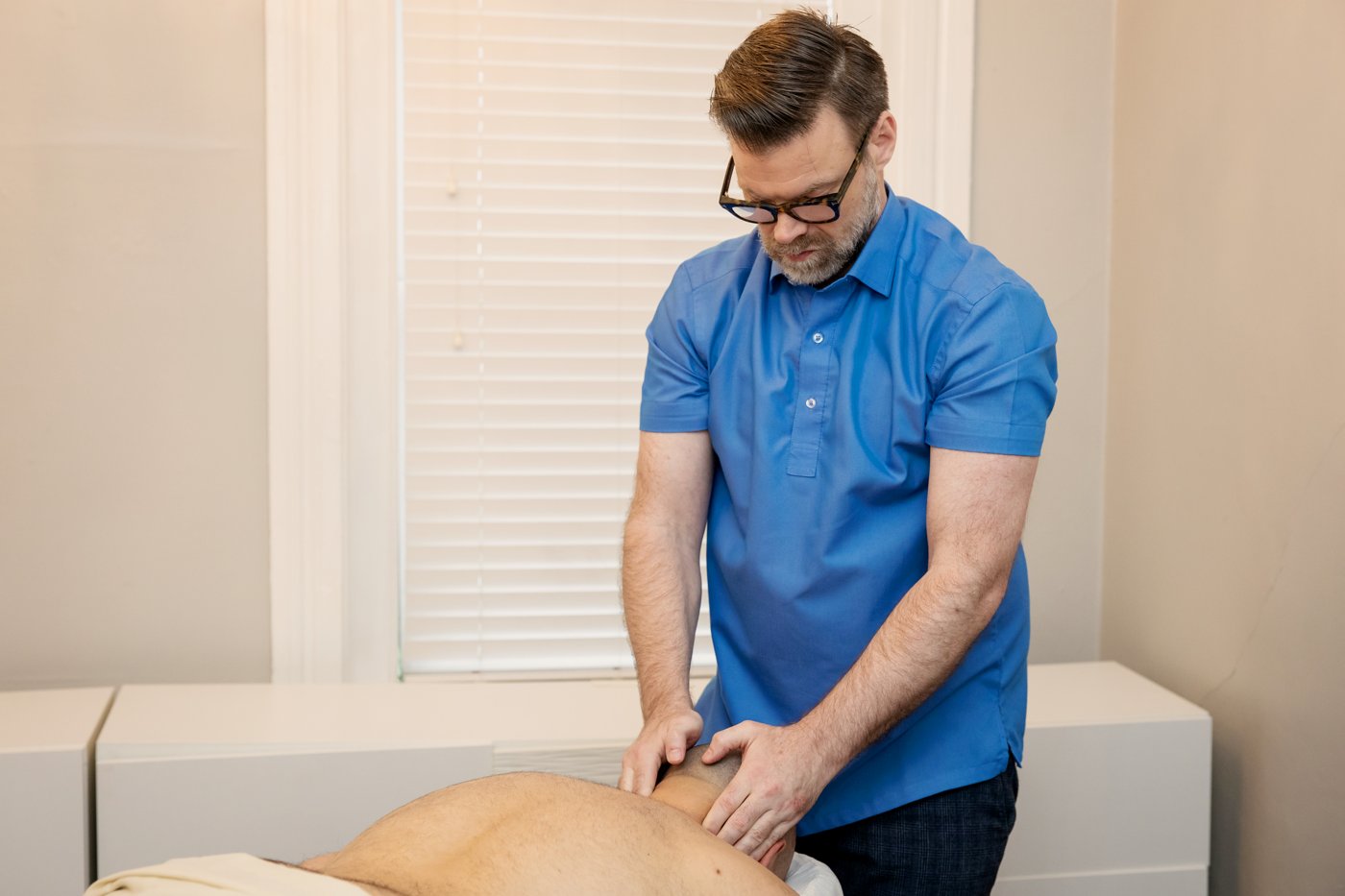
I don't approach scoliosis as something to straighten. The curve is structural. But the muscular pain, the stiffness, the fatigue from constant compensation. Those are things I can address directly. My focus is on releasing the muscles that are locked short, supporting the ones that are overstretched, and restoring as much balance as your body's structure allows.
Using neuromuscular therapy (skilled muscle release) and myofascial release (sustained pressure on connective tissue), I work along the full chain of compensation—not just where it hurts, but where the tension originates (Negrini et al., 2018). For most scoliosis clients, that means detailed work along the muscles along the spine, the deep low back, the intercostals between the ribs, and often into the hips and shoulders where the asymmetry plays out.
Every session begins with assessment. I look at how you stand, how you carry yourself, where the imbalances are most pronounced that day. Scoliosis doesn't present the same way every visit. Your body shifts, and the work needs to shift with it.
Clients with scoliosis often tell me they've accepted the pain as permanent. After consistent work, most find they can reclaim a level of comfort and mobility they didn't think was available to them. The curve stays, but the suffering doesn't have to. Your body has been adapting to this your whole life. With the right support, it can adapt toward less pain, not more.
Working With Scoliosis at Different Stages of Life
Scoliosis presents differently at different ages, and the work has to meet you where you are. Adolescents, still growing, usually aren't candidates for massage as a standalone approach—they need orthopedic monitoring, and sometimes bracing or Schroth-method PT depending on the degree of curve (Weinstein et al., 2008; Negrini et al., 2018). For teens whose medical team has cleared bodywork, massage can ease the muscular discomfort that comes with a growing, curving spine, but I always coordinate with their primary provider first.
Adults with established scoliosis are the most common clients I see. By adulthood, the curve has usually settled, and the real day-to-day problem is the decades of compensation on top of it. One hip sits higher, one shoulder rides forward, the ribs rotate, the muscles along the spine are asymmetrically loaded. The work at this stage is maintenance and relief — releasing the chronically shortened side, supporting the overstretched side, and helping you rebuild comfort in your own posture.
Post-fusion clients are a separate conversation. If you've had a spinal fusion, the hardware is permanent and we work entirely around it: no pressure directly over the fusion, careful attention to the hypermobile segments above and below that are now compensating for the fixed section. Most post-fusion clients tell me the muscular pain above or below the hardware is worse than anything the surgery itself addressed. That's where targeted bodywork genuinely helps. If you're considering fusion and want to help your body get into the best possible shape beforehand, pre-surgical sessions can also make a real difference in recovery.
References & Further Reading
- Weinstein SL, Dolan LA, Cheng JC, Danielsson A, Morcuende JA. (2008). Adolescent idiopathic scoliosis. The Lancet, 371(9623): 1527–1537.
- Travell JG, Simons DG. (1992). Myofascial Pain and Dysfunction: The Trigger Point Manual. Volume 2: The Lower Extremities. Baltimore: Williams & Wilkins.
- Negrini S, Donzelli S, Aulisa AG, et al. (2018). 2016 SOSORT guidelines: Orthopaedic and rehabilitation treatment of idiopathic scoliosis during growth. Scoliosis and Spinal Disorders, 13: 3.