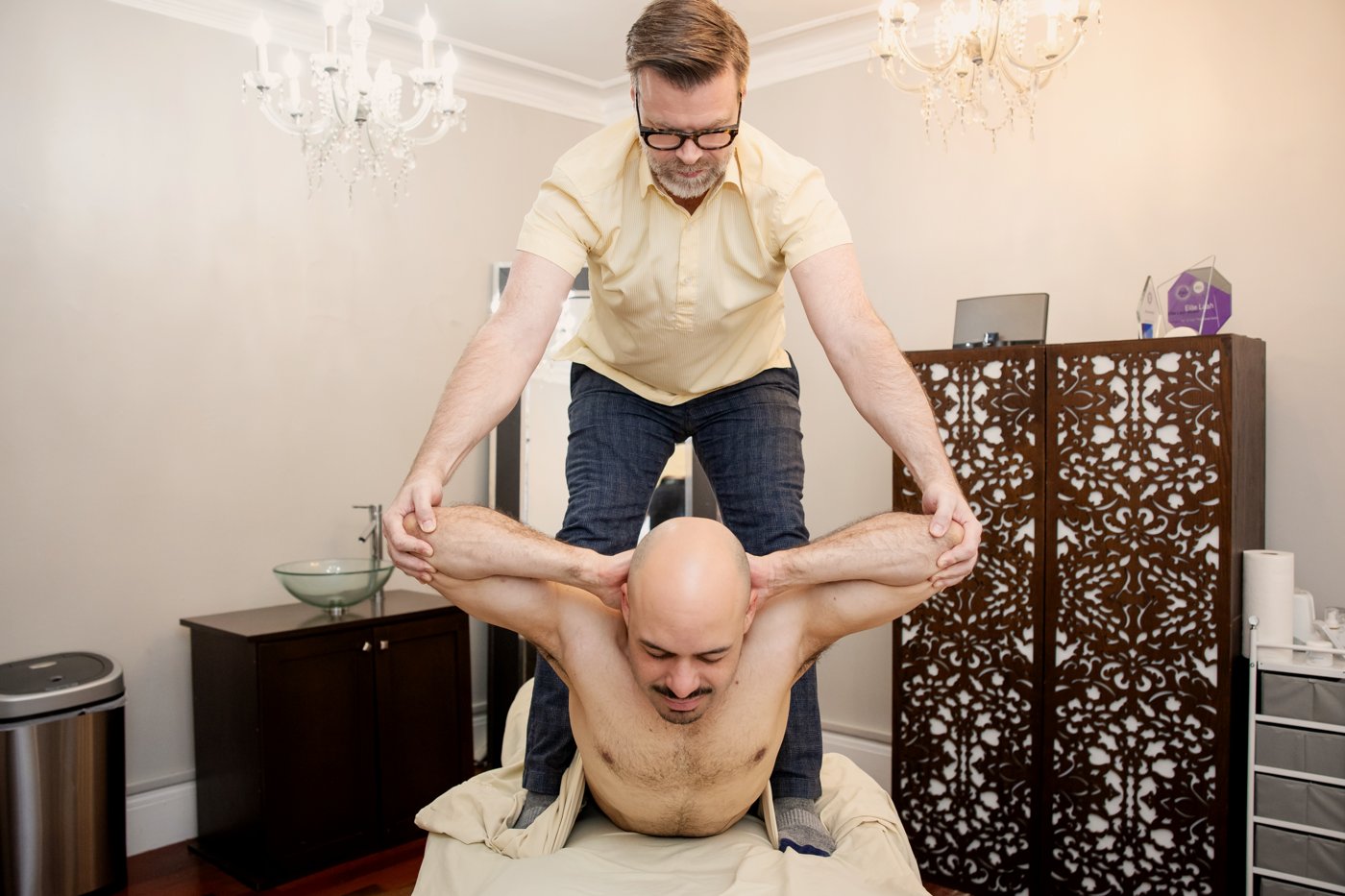
This is sports massage in Boston's Back Bay — deep tissue and neuromuscular work for athletes at every stage of recovery, from the first weeks after an injury to returning at full strength.
Whether you injured yourself last month in a pickup game or years ago in a formal competition, your body carries the memory of that impact. Even after the acute pain subsides, the muscles remain tight, movement patterns shift to protect the area, and you develop compensations that can lead to new problems down the road.
Athletes understand this instinctively. You know that coming back from injury takes more than clearance from your doctor. It means rebuilding strength, restoring full range of motion, and getting your confidence back. That's where deep tissue and neuromuscular work becomes essential. You need someone who understands how athletes move and what recovery truly requires.
Working With Athletes on Recovery
I work with athletes at every stage: post-injury when you're ready to start rebuilding, pre-surgical to prepare your body and improve outcomes, and post-surgical to accelerate recovery and reclaim full function. Each phase requires a different approach, but the goal is consistent — restoring capability and confidence.
During sessions, I focus on breaking down scar tissue, releasing protective muscle tension, restoring mobility, and rebuilding the tissue resilience you need to perform. I work the entire movement chain, not only the injury site, to help you recover completely.
Most athletes see significant improvement in mobility, pain, and performance capacity within 4–6 sessions. You'll feel stronger, move more freely, and have the confidence to return to your sport at full capacity.
Runners
Running is high-repetition impact loading — every stride drives force through the same chain of muscles, joints, and connective tissue. The patterns I see most in runners are tight hip flexors and calves, piriformis and IT band problems, and glutes that have stopped firing the way they should. Gluteus medius weakness in particular is well-documented as a driver of downstream knee, IT band, and plantar fascia problems in distance runners (Reiman et al., 2012). When the glutes go quiet, the hamstrings and low back pick up the slack, and that’s when the nagging injuries start — plantar fasciitis, shin splints, runner’s knee, low back pain that shows up at mile four and won’t let go.
I work the hip flexors and calves to restore range of motion, release the piriformis and the muscles loading the IT band, and address the glute inhibition that’s usually driving the whole pattern (Tonley et al., 2010). If you’re training for a race, regular sessions every two to three weeks help you stay ahead of developing problems instead of running through them until something breaks. Post-race recovery work — 48 hours after a long effort — clears out the adhesions and tension before they set in permanently.
Golfers
The golf swing is a rotational movement that loads the same structures the same way, hundreds of times per round. The low back and hips take the brunt of it. Most golfers I work with come in with one-sided tightness through the hip flexors and glutes, restricted thoracic rotation, and low back pain that flares after 14 holes. The lumbar spine is compensating for hips that won’t rotate and a mid-back that’s locked up from sitting all week — the lower-crossed pattern Janda (1987b) described, expressed under rotational load.
I work the hip rotators, release the QL and erectors on the loaded side, and open up thoracic mobility so the rotation can come from where it's supposed to instead of grinding through the low back. Most golfers notice they're finishing their swing more comfortably within a few sessions. And the low back stops punishing them the next morning.
Cyclists
Cycling loads the anterior chain relentlessly — hip flexors shortened, quads overworked, shoulders rounded forward over the bars. The posterior chain goes quiet. Over months of training, the TFL and glute max get over-recruited and load the IT band, the piriformis locks up, and the glutes stop firing the way they should. That's when the knee pain starts, or the low back ache that shows up 30 miles into a ride and won't let go.
The work for cyclists is about restoring the balance between front and back. I release the hip flexors and quads, work the muscles loading the IT band and the piriformis, and wake up the glutes so they can do their job on the pedal stroke again. If you're training for a century or a race season, regular maintenance every two to three weeks keeps developing problems from becoming real injuries.
Lifters
Lifters usually know their bodies well, but the patterns I see most are shoulder impingement from pressing volume, biceps tendonitis from anterior-dominant programming, and low back tightness from deadlift and squat cycles. Scapular muscle recruitment shifts under impingement — the lower trap and serratus fire late while the upper trap fires early (Cools et al., 2003) — and the same imbalance shows up at the hip in lifters whose squat patterning has the lumbar erectors compensating for inhibited glutes. The common thread is an underdeveloped posterior chain — the back of the shoulder, the lower traps, the glute medius — that can’t keep up with the load the front of the body is handling (Page, Frank & Lardner, 2010).
I work the rotator cuff and posterior shoulder to restore balance around the joint, release the chronically tight pecs and anterior deltoids that are pulling the shoulder forward, and address the hip and low back patterns that develop when the glutes aren't doing their share of the work under load. If you're mid-cycle and something's not right, a single targeted session can help you get back to training without losing momentum.
Training Cycles and When to Book
When you book matters almost as much as what we work on. Pre-event sessions (three to five days out from a race, match, or competition) should be about flush-and-release, not deep work. Going too deep too close to an event leaves tissue tender and can cost you performance. Save the real therapeutic depth for the off-season or for the days immediately after a hard effort, when your body can actually integrate the work. Most endurance athletes I see benefit from a 60- or 75-minute session 48 hours after a long effort; that's when scar-tissue adhesions and taut bands are ready to move.
Mid-season, a regular maintenance rhythm every two to three weeks keeps nagging issues from turning into real injuries. This is the most underrated use of massage in a competitive athlete's routine. Small tension patterns compound over a season; addressing them early keeps you in training instead of sidelined. For most clients, a 60-minute session at this cadence is enough to stay ahead of anything developing.
For acute injuries (something just pulled, twisted, or torqued), wait until the inflammatory phase has passed before coming in. The first 72 hours are for ice, rest, and medical evaluation if needed. After that, gentle work starts the recovery. For post-surgical return-to-play, I coordinate with your orthopedic team and PT on timing. The goal is always to have you back in your sport at full capacity, not just pain-free but confident in the movement patterns that got injured in the first place.
Related: Posterior chain imbalance · Biceps tendonitis · Runner’s knee · Plantar fasciitis · Marathon recovery
References & Further Reading
- Reiman MP, Bolgla LA, Loudon JK. (2012). A literature review of studies evaluating gluteus maximus and gluteus medius activation during rehabilitation exercises. Physiotherapy Theory and Practice, 28(4): 257–268.
- Tonley JC, Yun SM, Kochevar RJ, Dye JA, Schroeder S, Tillman MD. (2010). Treatment of an individual with piriformis syndrome focusing on hip muscle strengthening and movement reeducation: a case report. Journal of Orthopaedic & Sports Physical Therapy, 40(2): 103–111.
- Janda V. (1987b). Muscle weakness and inhibition (pseudoparesis) in back pain syndromes. In: Grieve GP, ed. Modern Manual Therapy of the Vertebral Column. Edinburgh: Churchill Livingstone.
- Cools AM, Witvrouw EE, Declercq GA, Danneels LA, Cambier DC. (2003). Scapular muscle recruitment patterns: trapezius muscle latency with and without impingement symptoms. American Journal of Sports Medicine, 31(4): 542–549.
- Page P, Frank C, Lardner R. (2010). Assessment and Treatment of Muscular Imbalance: The Janda Approach. Champaign, IL: Human Kinetics.