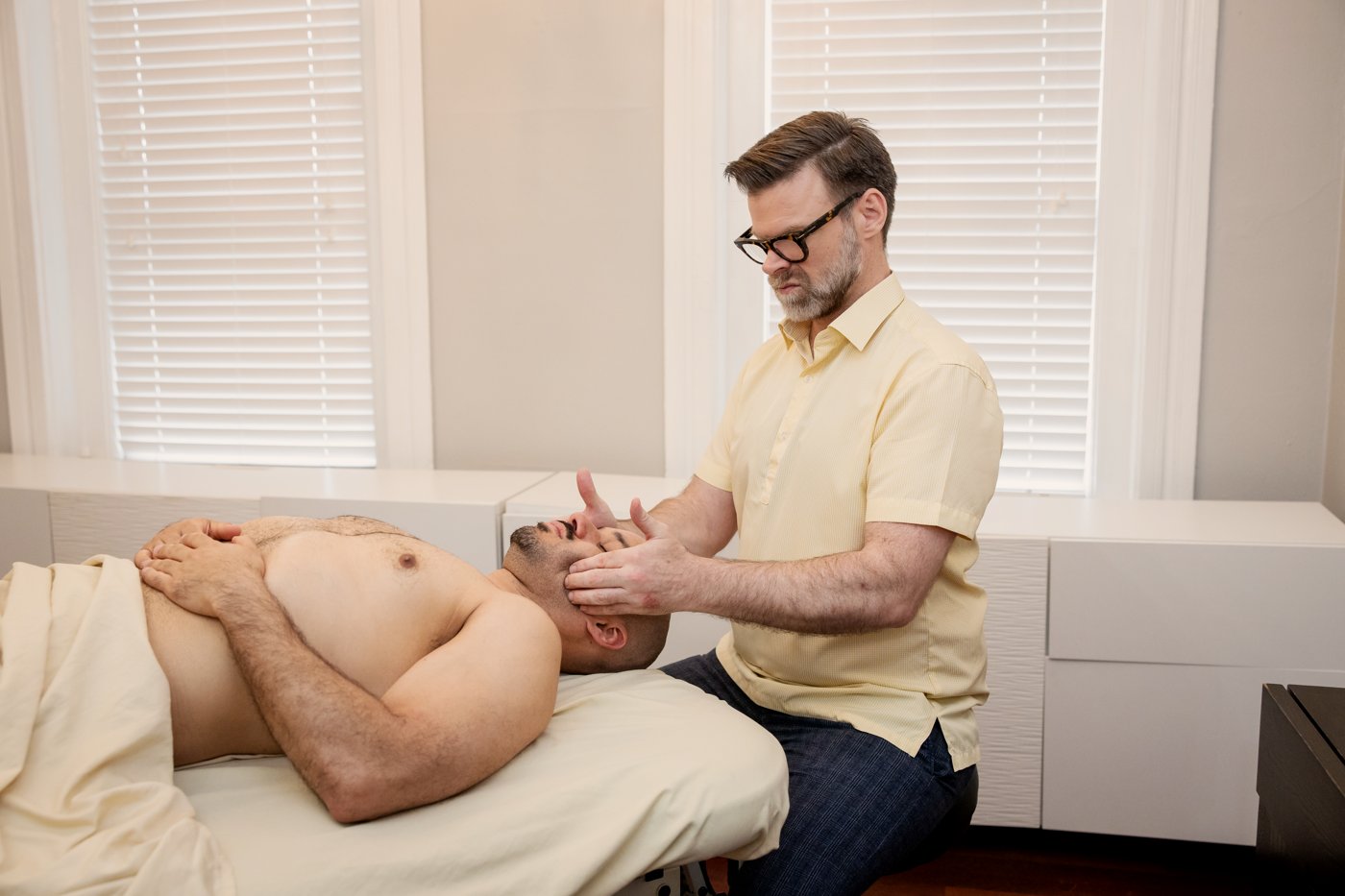
TMJ pain isn't just about your jaw. You probably know that already. You've felt it radiate through your temples, create tension in your neck, pull at your shoulders, and sometimes trigger ear pain that makes you wonder if something's wrong there too. Your jaw joint is connected to everything, and when it's out of balance, those ripples affect multiple systems.
The frustrating part is that most people treat the jaw in isolation. They see a dentist about their bite, take muscle relaxers, or try to rest it. But the jaw isn't the only thing that matters. Your neck, your shoulders, your upper traps, and your posture all feed into what's happening at the jaw joint. TMD is multifactorial: muscular (the masseter and temporalis muscles can become chronically tight), articular (sometimes the disc shifts), and central (stress and bruxism play major roles) (Okeson, 2013). If you're only addressing the jaw itself, you're missing half the picture.
How I Work With the Jaw Complex
I work the entire system. Yes, I address the jaw muscles directly, the masseter at the angle of your jaw and the temporalis at your temples that control chewing, but I also focus on the neck, shoulder, and upper traps that create the postural and muscular patterns driving jaw tension in the first place (Travell & Simons, 1999). The cervical spine and jaw are strongly linked: neck dysfunction loads the jaw, and jaw tension loads the neck. That connection is where most treatments miss the mark.
When you come in, I assess how your whole upper body is contributing to the problem. Often the real issue starts in your shoulders or neck and expresses itself through TMJ pain. Once I understand the pattern, I release the tension systematically, working to reclaim full range of motion in your jaw and eliminate the referred pain that's been affecting your life. Manual therapy for TMD—when applied to the muscles of mastication and the cervical chain—has strong evidence for reducing pain and restoring function (Calixtre et al., 2015).
Most clients find that once the entire jaw-neck-shoulder complex is addressed, the recurring headaches ease, ear pain resolves, and they can finally chew and talk without thinking about pain. You'll notice improvements quickly, sometimes within the first session.
Night Guards, Grinding, and Stress Patterns
A lot of TMJ clients come in wearing a night guard their dentist recommended. Night guards are useful (they protect your teeth from the damage grinding causes), but they don't address the underlying muscular tension that's driving the grinding in the first place. You can wear a guard every night for years and still wake up with a locked jaw, tension headaches, and soreness in your temples. The guard is a reasonable defense; it's not a strategy for the muscles themselves. That's where this work fits in.
Grinding almost always has a stress-pattern component. The jaw muscles are some of the first places the body routes accumulated tension, and nighttime is when that tension has the most uninterrupted time to work itself out. This connects to Janda's concept of upper crossed syndrome—where cervical extensors and jaw muscles are tight while deep neck flexors are inhibited, creating a feedback loop between neck and jaw dysfunction (Janda, 1987a). Clients who've added regular bodywork to their routine often report their partners noticing less grinding before they do. The sound just quiets down. If your dentist has noted your guard wearing down, or you wake with your jaw set and aching, that's worth paying attention to. Your jaw is telling you something about daytime stress you may not be consciously tracking.
On intraoral work: I don't do intraoral techniques as a standard part of TMJ sessions. It's a specialized approach that requires specific training and a dental referral in most cases, and the external work on the jaw muscles, the jaw muscles at your temples, and the neck and shoulder chain gets most clients the relief they're looking for. If after several sessions your presentation calls for intraoral work, I'll refer you to a colleague who specializes in it. Most clients never need it.
References & Further Reading
- Okeson JP. (2013). Management of Temporomandibular Disorders and Occlusion, 7th ed. St. Louis: Mosby/Elsevier.
- Travell JG, Simons DG. (1999). Myofascial Pain and Dysfunction: The Trigger Point Manual. Volume 1: Upper Half of Body, 2nd ed. Baltimore: Williams & Wilkins.
- Calixtre LB, Moreira RFC, Franchini GH, Alburquerque-Sendín F, Oliveira AB. (2015). Manual therapy for the management of pain and limited range of motion in subjects with signs and symptoms of temporomandibular disorder: A systematic review of randomised controlled trials. Journal of Oral Rehabilitation, 42(11): 847–861.
- Janda V. (1987a). Muscles and motor control in cervicogenic disorders. In: Grant R, ed. Physical Therapy of the Cervical and Thoracic Spine. New York: Churchill Livingstone.