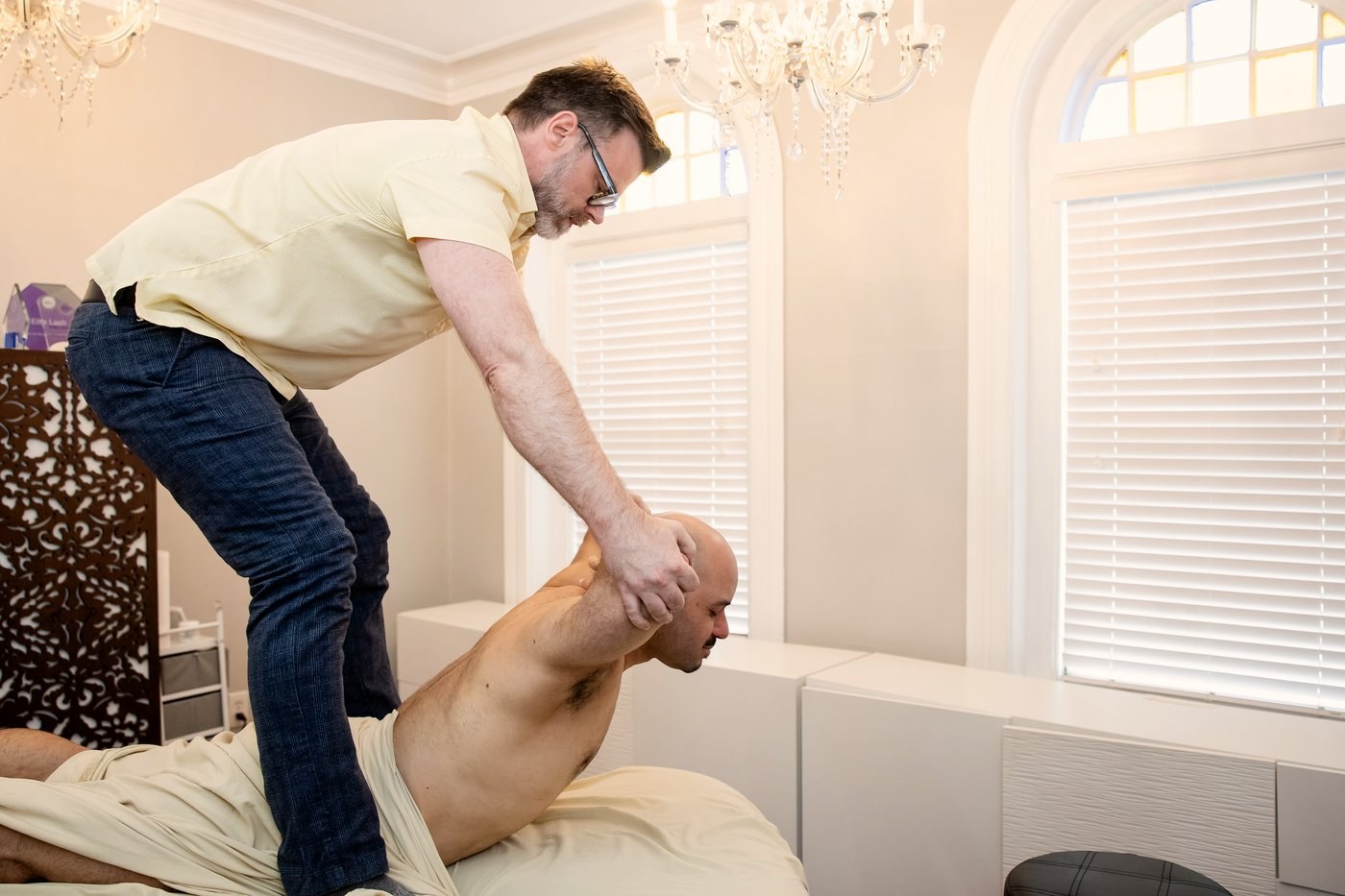
This is probably the most counterintuitive thing a massage therapist can tell you: for most people, the long-term answer to their physical problems is not more massage. It’s fitness. Massage is how we strip away the dysfunction — the chronic tension, the compensation patterns, the adhesions that have been building up for months or years. It gets your body back to a place where real movement is possible again. But holding that correction? That takes strength. And strength is something you build, not something I can give you in a session.
Two halves of the same equation
Think of it this way. Your body has been compensating for a long time. Maybe your glutes shut down and your low back picked up the slack. Maybe your posterior deltoids never developed and your upper traps took over. Maybe your hip flexors locked down because your core wasn’t doing its job. Whatever the pattern, massage can release those compensations. I can get your tissue back to a baseline where things move the way they should. After a few sessions, you feel different. The pain that’s been dragging on for months finally lets up.
But here’s the thing. If the muscles that were supposed to be doing the work are still weak, your body will drift right back into the same pattern. Not because the massage didn’t work. Because there’s nothing holding the correction in place. The pattern returns because the conditions that created it haven’t changed. This is the central finding in the strengthening literature: release without retraining the weak muscles simply lets the imbalance return (Page, Frank, and Lardner, 2010).
The muscles you can’t see are the ones protecting you
The same pattern shows up again and again. The muscles across the back of the body, your posterior chain, are underbuilt. Glutes, gluteus medius, posterior deltoid, the stabilizers along the spine. These are the muscles you can’t see in the mirror, so most people don’t train them. But they’re the ones protecting your back, your knees, your neck, your shoulders. The glutes especially: gluteus maximus and gluteus medius are the primary external hip rotators and hip stabilizers, and their weakness during daily movements creates compensation patterns across the kinetic chain (Reiman, Bolgla, and Loudon, 2012).
When those muscles are strong, your body has what it needs to maintain good posture without effort, absorb impact without injury, and resist the patterns that cause chronic pain. When they’re weak, everything in front tightens up to compensate — your hip flexors, your pecs, your biceps, your upper traps. That’s the pattern I release in session. And that’s the pattern fitness prevents from coming back.
This isn’t a sales pitch against my own work
I’m not saying massage doesn’t matter. It does. For acute injuries, for pain that’s been limiting your movement, for compensation patterns that have been building for years — massage is how we clear the path. The initial series of sessions is critical. You need someone to identify what’s going on, release the restrictions, and get your body moving the way it should. That’s my job, and I take it seriously.
What I’m saying is that massage alone isn’t the finish line. The clients who do best long-term are the ones who take the work we do together and build on it. They find a trainer or a Pilates instructor. They start a consistent program that targets the specific weaknesses their body has. They come back for maintenance, once a month for most people, and we keep the tissue healthy while their strength does the heavy lifting.
What “strong enough” actually means
I’m not talking about bodybuilding. I’m not talking about CrossFit or marathon training or anything that requires a gym membership and a meal plan. “Strong enough” means your muscles can do their job without help from muscles that shouldn’t be doing that job. It means your glutes fire when you walk up stairs so your low back doesn’t have to. It means your posterior deltoids are developed enough to hold your shoulders where they belong so your upper traps can finally let go.
For some people, that’s three days a week with a personal trainer. For others, it’s a twice-weekly Pilates class. For others, it’s a home routine with resistance bands and a foam roller. The specifics depend on your body, your goals, and what you’ll actually do consistently. The best exercise program is the one you show up for.
When to start
If you’re in the middle of an initial treatment series, those first four to six weekly sessions where we’re clearing out the backlog, that’s not the time to start a new fitness program. Your body is changing week to week. Let the massage do its job first. Get to baseline.
Once things stabilize — your pain is manageable, your range of motion is back, the compensation patterns have broken — that’s when fitness becomes the priority. I’ll tell you when we’re there. And I’ll tell you what specifically your body needs, because I’ve been working on it and I know where the weaknesses are. The research on inhibited muscles is clear: they need active retraining after release work, not just passive treatment (Janda, 1987b).
The goal is to see you less
I mean that. If you’re on my table every week for months without a clear reason, something isn’t working. The point of the work is to get you to a place where monthly maintenance is enough — where your body is strong enough to hold its own between sessions. When we get there, you’ll know. The intervals stretch out naturally. The pain doesn’t come back the way it used to. Your body has what it needs.
That’s what “let’s help you get strong enough” means. Not strong enough for someone else’s standard. Strong enough for your body to protect itself. Strong enough that the work we do together lasts.
Related reading: Why almost every pain pattern comes back to the posterior chain · What to expect in your first 4–6 weeks · Sports injury treatment
References & Further Reading
- Reiman MP, Bolgla LA, Loudon JK. (2012). A literature review of studies evaluating gluteus maximus and gluteus medius activation during rehabilitation exercises. Physiotherapy Theory and Practice, 28(4): 257–268.
- Page P, Frank C, Lardner R. (2010). Assessment and Treatment of Muscular Imbalance: The Janda Approach. Champaign, IL: Human Kinetics.
- Janda V. (1987b). Muscle weakness and inhibition (pseudoparesis) in back pain syndromes. In: Grieve GP, ed. Modern Manual Therapy of the Vertebral Column. Edinburgh: Churchill Livingstone.