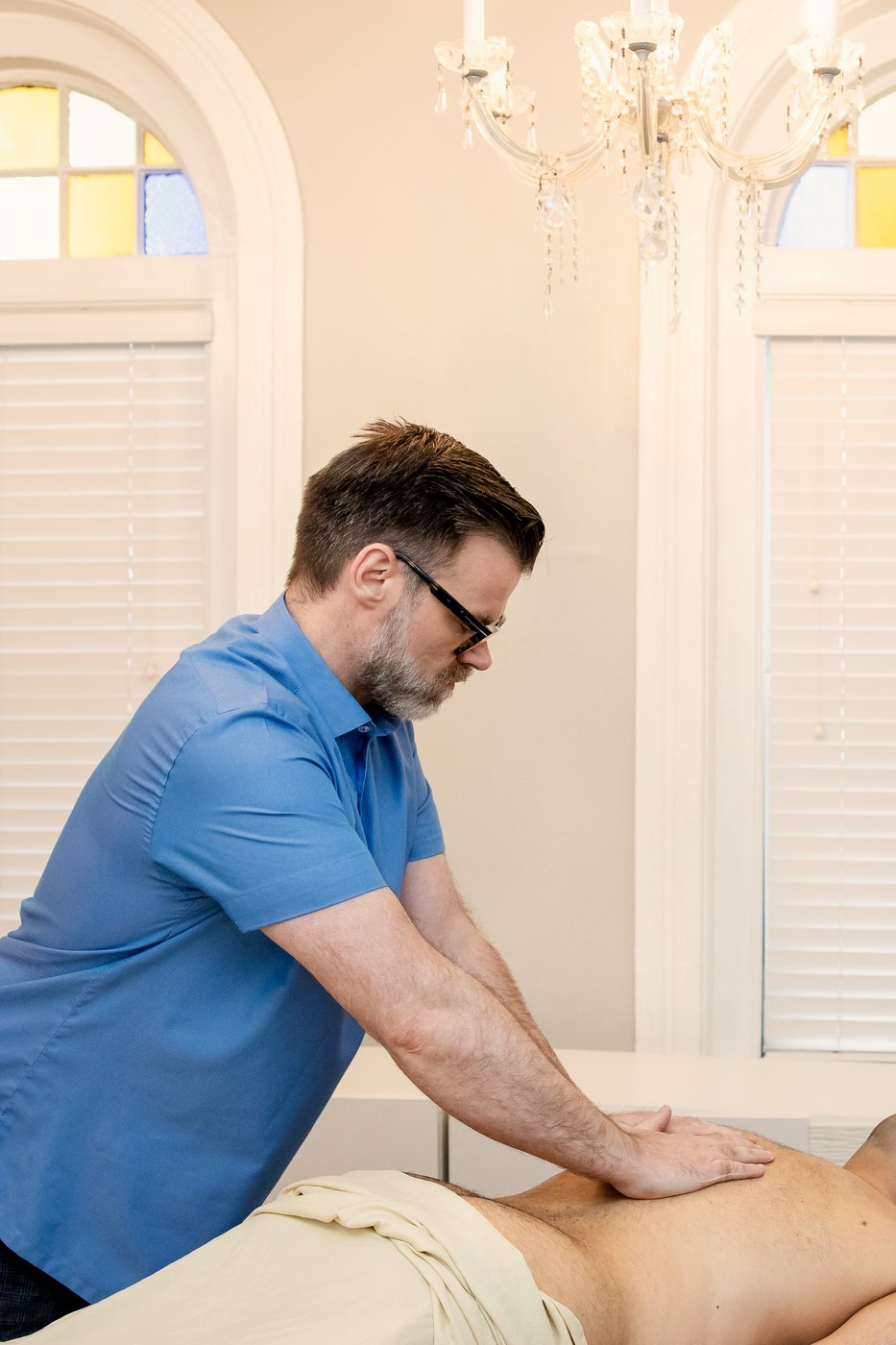
The same pattern shows up in my treatment room again and again. Different complaints, different bodies, different ages and activity levels — but the deeper cause is almost always the same. The pulling and stabilizing muscles across the back of the body are underbuilt. The front of the body has been doing too much for too long. And eventually, somewhere in the system, that imbalance turns into pain. Janda (1987a; 1987b) catalogued this pattern decades ago as upper- and lower-crossed syndrome, and it remains the cleanest framework I know for thinking about why pain in one region builds restrictions everywhere else.
Most of my clients work in offices — or, increasingly, work from home in setups that are even worse than what they had at the office. They’re in demanding jobs, stressed, and their bodies carry it. Even the ones who go to the gym regularly tend to come in with a soft posterior chain. The back of the body just doesn’t get trained by default. You have to do it on purpose.
What the posterior chain actually is
The posterior chain is the working name for the muscles that run up the back of your body and stabilize you from behind. The major players: the glutes, the gluteus medius (a smaller muscle on the side of your hip that controls how your pelvis behaves with every step), the hamstrings, the muscles along your spine, the muscles between your shoulder blades and the lower traps, and the back of your shoulder.
These are the muscles that pull you upright. They’re the counterweight to the chest, the abs, the hip flexors, and the front of the shoulder — everything that pulls you forward and inward. When the posterior chain is doing its job, your body sits in balance. When it’s not, the front wins, and the body gets pulled forward, rounded, and locked into patterns that quietly become pain.
Why this shows up most in office workers
Sitting is the dominant posture of modern adult life, and sitting trains the front of your body and shuts off the back. The hip flexors shorten. The glutes go quiet. The chest tightens. The back of the shoulder never gets recruited. Eight to ten hours a day, five days a week, for years — and the body adapts to that posture as the new neutral.
Working from home has made this worse for some of the clients I see. Office chairs are at least adjustable. The kitchen table or the couch isn’t. People sit hunched over a laptop on a soft surface for hours at a time, and their bodies pay for it. Add in the stress of the work itself — deadlines, video calls, mental load — and the upper traps and chest stay locked tight all day. The posterior chain never gets a turn.
Even regular gym work doesn’t always solve this. A lot of gym programming is front-dominant by default — bench press, biceps, quads, abs. The pulling and back-of-shoulder work tends to be undercooked even in people who train consistently. They build a strong front on top of a quiet back, and the imbalance just gets more pronounced.
The neck-pain pattern: the clearest example
Of all the pain patterns this creates, chronic neck pain is the one I see most. When the back of your shoulder isn’t holding up its share of stabilizing the shoulder blade, your upper traps and the muscles that run from your neck to your shoulder blade take over. Those muscles weren’t built for that job. They’re designed to elevate the shoulder and tilt the head — accessory work, not full-time stabilization. The recruitment shift has been measured directly in subjects with shoulder impingement: the lower trapezius and serratus anterior fire late, the upper trap fires early (Cools et al., 2003). Asked to do something they weren’t built for, those upper structures tighten, develop trigger points, and become one of the most common sources of chronic neck pain I see in practice.
Clients come in for years of neck pain. We work the upper traps and the levators, and they get real relief from the session. But the pattern returns within days, sometimes hours, because nothing has changed about why those muscles are overworked in the first place. As long as the posterior shoulder is asleep, the upper traps will keep stepping in to do its job. And the neck pain will keep coming back.
Reversing chronic neck pain almost always involves waking up the back of the shoulder. Once the posterior chain starts carrying its share of the load, the upper traps finally get to release. The relief from the table starts to last between sessions. The pain begins to ease in a way that holds. In my practice, an underdeveloped back shoulder is one of the biggest hidden drivers of the chronic neck pain pattern that brings people to me in the first place.
Same story, different pain
Chronic low back pain is a glute problem more often than it’s a back problem. When the glutes are quiet, which they are in most people who sit all day, the low back muscles take over the stabilization the glutes were supposed to provide. Those muscles tighten, fatigue, and start to ache. People stretch their low back, foam roll their low back, ice their low back. The back keeps hurting. The glutes are the unaddressed cause.
Knee pain in active adults is often a gluteus medius problem. The gluteus medius controls how your pelvis behaves with every step. When it’s weak, the pelvis drops slightly to the unsupported side and the knee tracks inward. Over thousands of steps a day, that subtle misalignment loads the knee in ways it isn’t built for (Reiman et al., 2012). The knee becomes the place that hurts, but the gluteus medius is the place that needs the work.
Tight biceps in someone who’s been resistance training is almost always a back-of-the-shoulder problem. The front of the arm overworks because the back of the shoulder isn’t doing its share of the stabilizing. Stretching the biceps doesn’t help; building the back of the shoulder does. I write more about that pattern specifically here →
What to actually do about it
The work is straightforward in principle and slow in practice. Build the back of your body on purpose. The high-value exercises are the same handful that trainers and physical therapists have been recommending forever — face pulls, band pull-aparts, glute bridges, single-leg work, deadlift variations done with good form, prone Y-raises. None of them are exotic. None of them require heavy weight. What they require is consistency — a few times a week, every week, for months and then for years. Page, Frank, and Lardner (2010) lay out the full Janda-approach progressions in detail; the key is consistency over load.
That’s the catch. The posterior chain doesn’t respond to a six-week program. It responds to a permanent shift in how you train and how you move. The clients who stay out of pain for the long haul are the ones who treat their posterior chain work as a non-negotiable part of their routine, the same way they treat brushing their teeth. The ones who don’t are the ones who keep coming back with the same complaints in different forms — tight biceps one season, low back trouble the next, knee discomfort the season after.
Massage is part of how you maintain that work. The hands-on piece releases the chronic tension at the front that’s pulling everything forward, identifies which specific patterns are most loaded in your body, and helps the posterior chain wake up to a degree that home exercise alone has a hard time reaching. But the strength has to be built. There’s no shortcut.
If you’re reading this and recognizing yourself — the chronic ache somewhere, the pattern that keeps coming back no matter what you try — that’s the entry point. The work isn’t in the place that hurts. It’s in the muscles you’ve never trained to carry their share.
Related reading: Posterior chain imbalance — the pattern explained · Why your biceps stay tight no matter how much you stretch them · Neck, back & shoulder pain · Sports injuries
References & Further Reading
- Janda V. (1987a). Muscles and motor control in cervicogenic disorders: Assessment and management. In: Grant R, ed. Physical Therapy of the Cervical and Thoracic Spine. New York: Churchill Livingstone.
- Janda V. (1987b). Muscle weakness and inhibition (pseudoparesis) in back pain syndromes. In: Grieve GP, ed. Modern Manual Therapy of the Vertebral Column. Edinburgh: Churchill Livingstone.
- Cools AM, Witvrouw EE, Declercq GA, Danneels LA, Cambier DC. (2003). Scapular muscle recruitment patterns: trapezius muscle latency with and without impingement symptoms. American Journal of Sports Medicine, 31(4): 542–549.
- Reiman MP, Bolgla LA, Loudon JK. (2012). A literature review of studies evaluating gluteus maximus and gluteus medius activation during rehabilitation exercises. Physiotherapy Theory and Practice, 28(4): 257–268.
- Page P, Frank C, Lardner R. (2010). Assessment and Treatment of Muscular Imbalance: The Janda Approach. Champaign, IL: Human Kinetics.