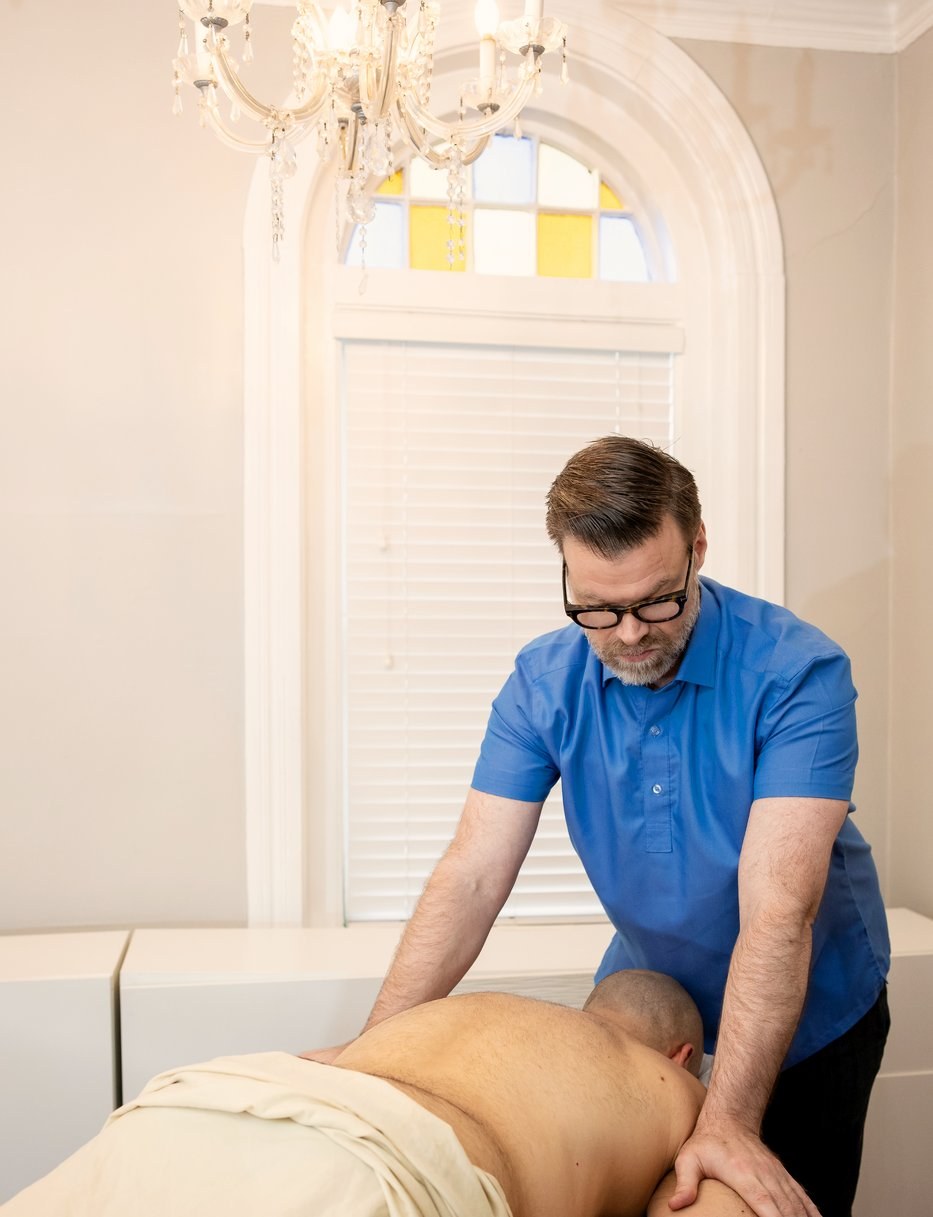
After twenty years in practice, the same pattern shows up again and again. People come in with neck pain, low back pain, knee pain, biceps tendonitis, plantar fasciitis, chronic headaches — different complaints, different bodies — and underneath, the same structural problem. The muscles that pull and stabilize across the back of the body are underbuilt. The muscles across the front are pulling everything forward to compensate. I see this in roughly ninety-eight percent of the clients who come in with chronic pain. That is not a research statistic. It is what I observe in the work, week after week, year after year.
The technical name for it is posterior chain imbalance. The clinical framework is older than I am. What is new is how universally it shows up in modern adults.
Upper Crossed Syndrome and Lower Crossed Syndrome
The clearest published description of this pattern came from the late Czech neurologist Vladimir Janda, who spent decades treating chronic pain and movement dysfunction. Janda described two predictable imbalance patterns that show up in modern bodies (Janda, 1987a; Janda, 1987b).
Upper crossed syndrome describes what happens above the waist. The chest, anterior deltoid, upper traps, and levator scapulae become chronically tight. The deep neck flexors, lower traps, rhomboids, and posterior deltoid become weak and inhibited. The shoulders pull forward, the head drifts in front of the spine, and the neck and shoulders carry the consequences. This is the pattern behind most chronic neck pain, headaches, biceps tendonitis, shoulder impingement, and what people now call “tech neck.”
Lower crossed syndrome describes the same kind of imbalance below the waist. The hip flexors and lumbar erectors become tight. The glutes, especially the gluteus medius, and the deep abdominals become weak and inhibited. The pelvis tilts forward, the lumbar curve deepens, and the low back, knees, and feet carry the consequences. This is the pattern behind most chronic low back pain, sciatica, runner’s knee, plantar fasciitis, and IT band syndrome.
These are not separate problems. They are two ends of the same chain. The body is a continuous system, and once one half drifts out of balance, the other usually follows.
What I Watch Go Quiet
Across thousands of sessions, three muscles show up underbuilt almost universally: the posterior deltoid, the gluteus medius, and the deep scapular stabilizers (rhomboids and lower traps). These are not rare anatomy. They are standard equipment. But almost nothing in modern daily life recruits them, and almost nothing in standard gym programming targets them specifically.
The posterior deltoid is one of three heads of the shoulder muscle. In someone whose daily life faces forward — typing, driving, carrying, reaching — and whose training emphasizes pressing over pulling, the posterior delt effectively stops being recruited. The body still has the muscle. It just stops using it (Cools et al., 2003).
The gluteus medius sits on the side of the hip and stabilizes the pelvis when you stand on one leg — which is to say, every step you take when walking or running. When the glute med is weak or inhibited, the pelvis drops on the unsupported side, the lumbar spine compensates, the IT band gets loaded under tension, the knee tracks poorly, and a chain of downstream problems begins (Reiman et al., 2012). Most of the runner’s knee, plantar fasciitis, and stubborn low back pain I work with has glute medius dysfunction sitting underneath it.
Why Stretching the Tight Side Doesn’t Resolve It
When the front of the body is chronically tight and the back is chronically lengthened and weak, stretching the tight side feels good for a few hours and then locks up again. It has to. The body is bracing against an imbalance that has not been corrected. Only one side of the equation has changed. Until the underbuilt side starts carrying its share of the load, the overbuilt side will keep guarding.
This is why foam rolling never sticks, why doorway stretches give four hours of relief, why the same shoulder pain comes back every six weeks. The pattern does not unwind from one direction.
What I Work On
The session work has two halves. First, releasing the chronically tight structures across the front — chest, anterior deltoid, hip flexors, quads — so the body has somewhere to settle into. Second, releasing the fascial restrictions and chronic guarding patterns over the underbuilt posterior structures so they can actually fire when you try to recruit them. Manual work does not build muscle. But it does open the window for muscle to be built.
Most clients feel a noticeable shift after the first session — usually a sense of being able to stand up straighter without effort, or move the shoulder without the usual catch. The deeper work, the kind that holds, usually takes three to four sessions over four to six weeks, paired with a home strengthening protocol for the underbuilt posterior structures.
Building It Back Up
The home protocol is short. Face pulls and band pull-aparts for the posterior deltoid and scapular stabilizers. Side-lying clamshells and single-leg glute bridges for the gluteus medius. Two to three rounds, two to three times a week, light resistance. Page, Frank, and Lardner (2010) lay out the full Janda-approach progressions in detail; the key is consistency over load.
The pattern took years to build. It does not take years to address. It takes a window of focused work, manual and active, and the discipline to keep recruiting muscles that modern life lets you forget.
Related reading: Why almost every pain pattern comes back to the posterior chain · Why your biceps stay tight no matter how much you stretch them · Neck, back & shoulder pain · Sciatica
References & Further Reading
- Janda V. (1987a). Muscles and motor control in cervicogenic disorders: Assessment and management. In: Grant R, ed. Physical Therapy of the Cervical and Thoracic Spine. New York: Churchill Livingstone.
- Janda V. (1987b). Muscle weakness and inhibition (pseudoparesis) in back pain syndromes. In: Grieve GP, ed. Modern Manual Therapy of the Vertebral Column. Edinburgh: Churchill Livingstone.
- Page P, Frank C, Lardner R. (2010). Assessment and Treatment of Muscular Imbalance: The Janda Approach. Champaign, IL: Human Kinetics.
- Reiman MP, Bolgla LA, Loudon JK. (2012). A literature review of studies evaluating gluteus maximus and gluteus medius activation during rehabilitation exercises. Physiotherapy Theory and Practice, 28(4): 257–268.
- Cools AM, Witvrouw EE, Declercq GA, Danneels LA, Cambier DC. (2003). Scapular muscle recruitment patterns: trapezius muscle latency with and without impingement symptoms. American Journal of Sports Medicine, 31(4): 542–549.