You stretch them. You foam roll them. You wait a few days. You stretch them again. And every time you go to the gym, by the end of the week, the front of your upper arm feels like one taut band from your shoulder to your elbow. Maybe one side worse than the other. The doorway stretch helps for about four hours. Then the tightness comes back.
I see this almost every week in practice — clients three or four months into resistance training, clients who’ve been lifting for years, clients who don’t lift at all but spend their days carrying kids or reaching forward at a desk. Different people, same complaint, same chronically tight biceps that won’t let go.
Here’s what almost no one tells you: the biceps aren’t the problem. They’re the symptom. And until you address what’s actually causing the tension, you can stretch them every day for the rest of your life and they’ll keep snapping back.
The biceps are working overtime because the back of the shoulder isn’t showing up
The front of your arm and the back of your shoulder are supposed to share the work. Pulling, lifting, stabilizing, carrying — all of it should be a balanced effort between the biceps and brachialis at the front and the back of the shoulder, the muscles between your shoulder blades, and the lower traps at the back.
In almost everyone, the back is undertrained. Modern life loads the front of the body relentlessly. You reach forward to type, drive, scroll, lift a child, push a stroller, carry a grocery bag. Almost nothing in a normal day asks the muscles between your shoulder blades or the back of your shoulder to engage. They get weaker. They stop participating.
What I see with real consistency is this: in a meaningful percentage of adult clients, the back of the shoulder is severely underdeveloped. It’s one of the three heads of your shoulder — a substantial, functional piece of anatomy — and in a lot of people it has effectively faded out of how their body operates. They’ve never trained it, nothing in daily life recruits it, and over the years it has simply gone quiet. The recruitment shift that comes with this isn’t hypothetical: the lower trapezius and serratus anterior fire late, the upper trap fires early, and the shoulder loses its posterior counterweight (Cools et al., 2003).
And it’s not just disuse. There’s an active mechanism keeping the back of the shoulder weak. The chronic tension across the front — tight chest, tight shoulder in front, tight biceps — physically pulls the shoulders forward and inward. That forward pull holds the muscles across the upper back in a chronically lengthened position. A lengthened muscle can’t generate force well; it’s mechanically disadvantaged. So the back of the shoulder gets weaker not just because nothing’s training it, but because it’s being held in a position where it can’t fire properly even when you try. This is the upper-crossed pattern Janda (1987a) catalogued — tight pectorals, anterior deltoid, and upper traps paired with inhibited lower traps, rhomboids, and posterior deltoid.
The tighter the front gets, the more stretched-thin the back becomes. The more stretched-thin the back is, the less it can do its job. The less it does its job, the more the front compensates. And the tighter it gets. A self-reinforcing cycle of tension at the front, weakness at the back, and the same complaint coming back week after week. A vicious cycle of pain and misery, as I see it in practice.
So what happens when you go to the gym and start curling, rowing, or pressing? The biceps step up to cover for what the posterior chain isn’t doing. They handle their own job and the stabilizing job that belongs to the back of the shoulder. After a few months of that, the front of your arm is locked up — not because it’s short, but because it’s carrying double the load.
This is why stretching them harder makes it worse
When you aggressively stretch a muscle that’s under load because it’s compensating, you take away its ability to do that compensation work — without giving the underdeveloped muscle anywhere to send the load. The body’s response is to brace harder. The biceps tighten back up within hours, sometimes more locked than before.
Gentle release work is fine. Foam rolling the front of the arm, easy doorway stretches at a 4 or 5 out of 10 — useful as part of a recovery routine. But deep, aggressive biceps stretching as a primary strategy is treating the smoke instead of the fire. The biceps will keep tightening as long as the back of the shoulder stays asleep.
What actually works: build the posterior chain
The single most useful exercise for chronic biceps tightness has nothing to do with the biceps. It’s the face pull. A light resistance band anchored at face height, palms facing each other, pulled toward your face with your elbows ending up wide and high — roughly in line with your ears. Two sets of twelve to fifteen, two or three times a week. You don’t need heavy weight. You need clean technique and consistency.
Add band pull-aparts — same band, held in front of you at shoulder height, pulled apart by squeezing the muscles between your shoulder blades. And prone Y-raises, lying face down on the floor with your arms extended in a Y, lifting just a few inches off the ground. No weight needed.
That’s the whole protocol. Three exercises, ten minutes, a few times a week. Within three to four weeks, most people start to notice the biceps easing up between training sessions even though they haven’t changed anything they’re doing for the biceps directly. The back of the shoulder takes the load it was always supposed to carry, and the front of the arm finally gets to recover. Page, Frank, and Lardner (2010) lay out the full Janda-approach progressions in detail; the key is consistency over load.
Where massage fits in
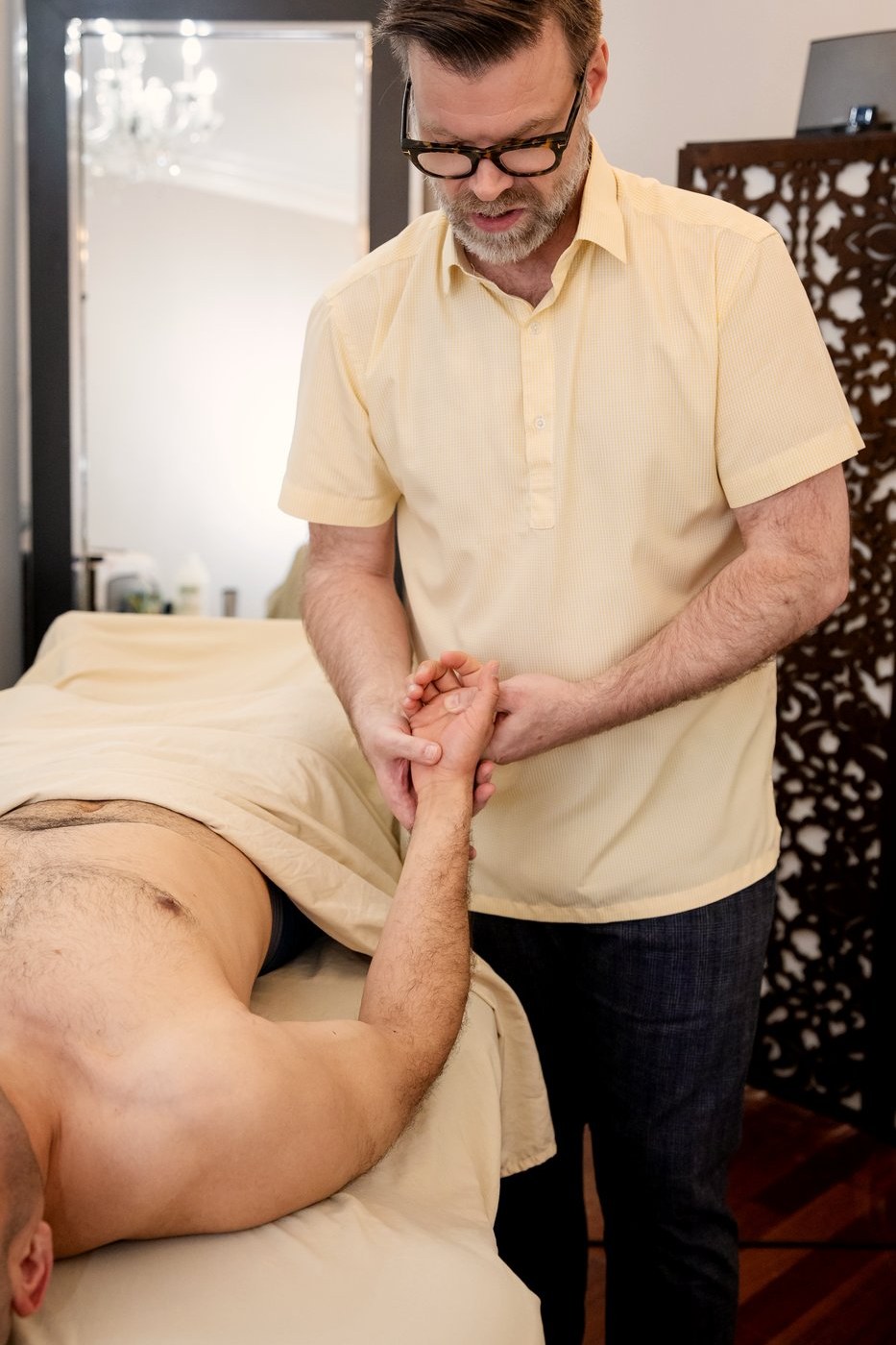
Manual work doesn’t build muscle. But it does two things the gym can’t. First, it releases the chronic guarding in the biceps and brachialis directly — specific pressure into the long head, the short head, and the layer underneath, in a way that no foam roller can reach. Trigger-point referral patterns from the biceps brachii and pec minor overlap directly with the chronic anterior-arm tightness most clients describe (Travell & Simons, 1999). Second, it identifies which surrounding patterns are contributing. Tight chest muscles that are pulling the shoulder forward. Locked-up upper traps that are overworking. Restricted fascia along the front of the shoulder that limits the back of the shoulder’s ability to engage even when you’re trying to recruit it.
Most clients dealing with this come in once, get the front of the arm released, learn the home protocol, and then come back every three or four weeks for maintenance while they build the back of the shoulder in the gym. Within a couple of months the biceps tightness stops being a daily story.
If this is you, if your biceps have been tight for months and nothing you’ve tried has stuck, the work isn’t in the front of your arm. It’s in the back of your shoulder. Once you know that, you can finally start to recover.
Tight biceps are an entry point. There’s a bigger picture behind them. Almost every chronic pain pattern I treat traces back to the same underbuilt posterior chain. I write about that bigger pattern here →
Related reading: Biceps tendonitis treatment · Posterior chain imbalance · Therapeutic massage for sports injuries · Neck, back & shoulder pain
References & Further Reading
- Janda V. (1987a). Muscles and motor control in cervicogenic disorders: Assessment and management. In: Grant R, ed. Physical Therapy of the Cervical and Thoracic Spine. New York: Churchill Livingstone.
- Cools AM, Witvrouw EE, Declercq GA, Danneels LA, Cambier DC. (2003). Scapular muscle recruitment patterns: trapezius muscle latency with and without impingement symptoms. American Journal of Sports Medicine, 31(4): 542–549.
- Travell JG, Simons DG. (1999). Myofascial Pain and Dysfunction: The Trigger Point Manual. Volume 1: Upper Half of Body, 2nd ed. Baltimore: Williams & Wilkins.
- Page P, Frank C, Lardner R. (2010). Assessment and Treatment of Muscular Imbalance: The Janda Approach. Champaign, IL: Human Kinetics.