Biceps tendonitis usually shows up as a sharp or deep ache at the front of your shoulder, right where the biceps tendon crosses the joint. It flares when you reach overhead, press, or curl. Rest helps for a while, then it comes back the moment you return to training or daily activity. Anti-inflammatories take the edge off but never resolve it. You’ve probably been told to ice it, rest it, maybe stretch it. And it keeps coming back.
That’s because the tendon isn’t the root cause. It’s absorbing the consequences of a pattern happening across your entire shoulder.
Why the Tendon Keeps Flaring
The biceps tendon runs through a narrow groove at the front of your shoulder. When everything is balanced (the back of the shoulder is strong, the chest and front shoulder aren’t pulling the joint forward), the tendon glides smoothly through that groove and handles the load it was designed for.
But when the back of the shoulder is weak and the front is chronically tight, the shoulder rolls forward. That narrows the groove. The tendon gets compressed, rubbed, and irritated with every movement. Meanwhile, the biceps muscle itself is overworking — compensating for the posterior shoulder muscles that aren’t doing their share. The lower trapezius and serratus anterior fire late, the upper trap fires early, and the same overworked structures keep loading the tendon (Cools et al., 2003). So the tendon is taking more load through a tighter space. That’s the recipe for tendonitis that won’t quit.
This is the same anterior-posterior imbalance I see behind most chronic upper body complaints. Janda (1987a) called this upper crossed syndrome — tight pectorals, anterior deltoid, and upper traps paired with inhibited deep neck flexors, lower traps, and rhomboids. Office workers who reach forward all day develop it. Lifters with pressing-dominant programs develop it. Cyclists hunched over bars develop it. The specific trigger varies, but the pattern is consistent.
What I Work On
The session isn’t about digging into the inflamed tendon. That would make things worse. The work is about releasing the structures that are creating the compression and overload in the first place.
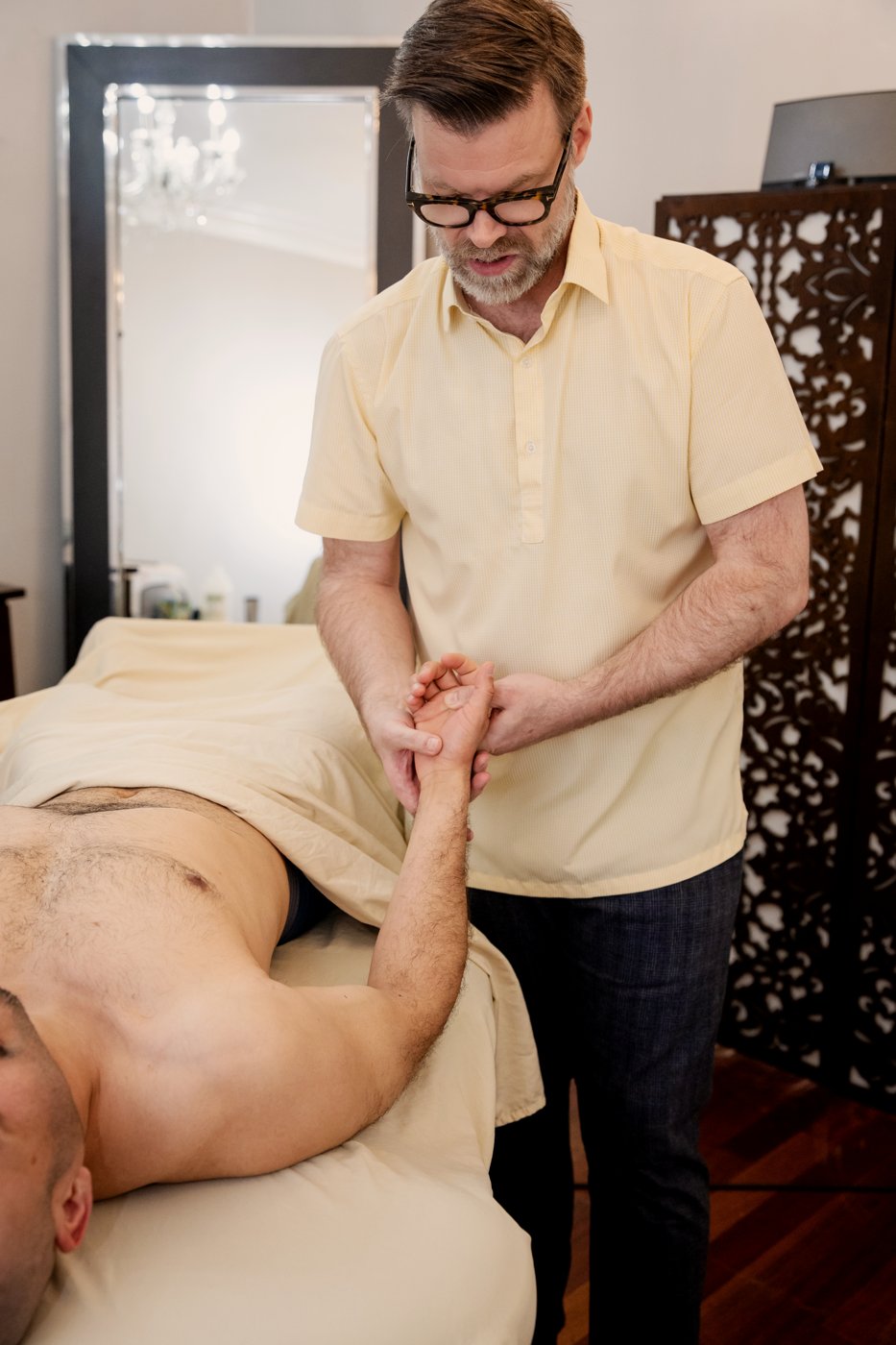
I start with the pectoralis minor and major — the chest muscles that are pulling your shoulder forward and narrowing the tendon groove. Then the anterior deltoid, which is usually locked short from the same forward-shoulder posture. From there, I work the biceps itself (both heads, plus the brachialis underneath), releasing the chronic tension that’s been loading the tendon beyond its capacity. Trigger-point referral patterns from the pec minor, infraspinatus, and biceps brachii overlap directly with the front-of-shoulder pain pattern most clients describe (Travell & Simons, 1999).
The second half of the session addresses the back of the shoulder directly. The posterior deltoid, the infraspinatus, the lower traps — the muscles that should be pulling the shoulder back into a balanced position but have gone quiet. I can’t build those muscles for you, but I can release the fascial restrictions and guarding patterns that are preventing them from engaging when you try to recruit them (Page, Frank & Lardner, 2010).
Most clients feel a noticeable reduction in that sharp front-of-shoulder pain after the first session. The deeper resolution, the one that keeps it from coming back, usually takes three to four sessions combined with a home strengthening protocol for the posterior shoulder.
Keeping It From Coming Back
The manual work creates the window. What you do in that window determines whether the tendonitis stays gone. Face pulls, band pull-aparts, and prone Y-raises — three simple exercises that rebuild the back of the shoulder so it can hold the joint in a balanced position under load. Two to three times a week, light resistance, clean technique. That’s the protocol.
If you’re a lifter, this usually means adjusting your programming — less pressing volume relative to pulling, at least until the balance is restored. If you’re at a desk all day, it means those posterior exercises become non-negotiable. The tendon will stay calm as long as the shoulder stays balanced.
Related reading: Why your biceps stay tight no matter how much you stretch them · Posterior chain imbalance · Sports injury recovery · Neck, back & shoulder pain
References & Further Reading
- Janda V. (1987a). Muscles and motor control in cervicogenic disorders: Assessment and management. In: Grant R, ed. Physical Therapy of the Cervical and Thoracic Spine. New York: Churchill Livingstone.
- Cools AM, Witvrouw EE, Declercq GA, Danneels LA, Cambier DC. (2003). Scapular muscle recruitment patterns: trapezius muscle latency with and without impingement symptoms. American Journal of Sports Medicine, 31(4): 542–549.
- Travell JG, Simons DG. (1999). Myofascial Pain and Dysfunction: The Trigger Point Manual. Volume 1: Upper Half of Body, 2nd ed. Baltimore: Williams & Wilkins.
- Page P, Frank C, Lardner R. (2010). Assessment and Treatment of Muscular Imbalance: The Janda Approach. Champaign, IL: Human Kinetics.