You’ve done the stretching. You’ve taken the ibuprofen. You’ve maybe done a round of physical therapy, or gotten a cortisone injection, or spent weeks on YouTube looking for the right piriformis stretch. It got better for a while. Then it came back. If you’re reading this, that cycle probably isn’t new to you. The pain down your leg eases up, you think you’re past it, and a few weeks or months later it returns — sometimes worse than before.
What I can tell you from sitting across this exact pattern week after week is that the reason your sciatica keeps coming back is almost always the same. The treatments you’ve tried have been addressing the pain without addressing what’s creating it. That’s not a knock on those treatments. They often do bring relief. But relief and resolution are different things.
The pain is real. It’s also the messenger.
Sciatica isn’t a diagnosis. It’s a description — pain along the sciatic nerve, usually running from the low back or buttock down the back of the leg. The question that matters is: what’s compressing or irritating that nerve?
In most of the clients I see, the answer falls into one of two categories. The first is the piriformis muscle — a deep hip rotator that sits directly on top of the sciatic nerve. The anatomical relationship is intimate: in roughly one in six people, the sciatic nerve actually pierces or splits around the piriformis (Beaton & Anson, 1937; Smoll, 2010). When this muscle gets chronically tight or locked up, it squeezes the nerve and produces that familiar burning, shooting pain down the leg (Travell & Simons, 1992). The second is lumbar compression — the muscles along your spine tightening around the nerve root where it exits the spine.
Here’s the part most people miss: both of these are downstream consequences of something else.
The glute connection no one talks about
The piriformis is a small muscle. It’s not built to be a primary stabilizer of your hip and pelvis — that’s the job of the gluteus maximus and the gluteus medius (Reiman et al., 2012). But in most people who sit for a living, the glutes are functionally quiet. They’ve been shut off by hours of sitting, day after day, year after year. The body still needs hip stability, so the piriformis steps in. It takes on a load it wasn’t designed for (Tonley et al., 2010). It tightens. And because it sits right on top of the sciatic nerve, that tightness becomes pain.
This is why stretching the piriformis gives temporary relief but doesn’t solve the problem. You’re loosening a muscle that’s tight for a reason. As long as the glutes aren’t carrying their share of the work, the piriformis will tighten back up. The compression returns. The sciatica comes back.
The same logic applies to lumbar-origin sciatica. When the glutes are weak, the muscles along your spine compensate by doing extra stabilization work. They tighten, fatigue, and eventually start compressing the nerve roots in the lumbar spine. Stretching the low back helps temporarily. But the tightness returns because the underlying imbalance hasn’t changed. This is the lower-crossed pattern Janda (1987b) described decades ago — tight hip flexors and lumbar erectors paired with inhibited glutes and deep abdominals. I write about this broader pattern, the posterior chain problem, in more detail here →
Why the common treatments don’t stick
Stretching can calm a tight piriformis temporarily, but it can’t strengthen weak glutes. And during an active flare, hamstring stretches often make things worse. They pull directly on an already-irritated sciatic nerve.
Anti-inflammatories reduce the inflammation around the nerve, which brings real relief. But they don’t change the mechanical compression that caused the inflammation in the first place. The pain returns when the medication wears off because nothing structural has shifted.
Cortisone injections do the same thing more aggressively — knock down inflammation at the site. They can be genuinely useful in a severe flare to break the pain cycle. But if the piriformis is still locked up or the lumbar muscles are still guarding, the compression rebuilds over weeks or months.
Physical therapy is closest to addressing root cause, and good PT is a valuable part of the picture. What I add is the hands-on assessment, feeling exactly which muscles are creating the compression in your body, so the strengthening work targets the right pattern. Not every sciatica case is a piriformis problem. Not every one is lumbar. The work has to match what’s actually happening in your tissue.
What actually changes the pattern
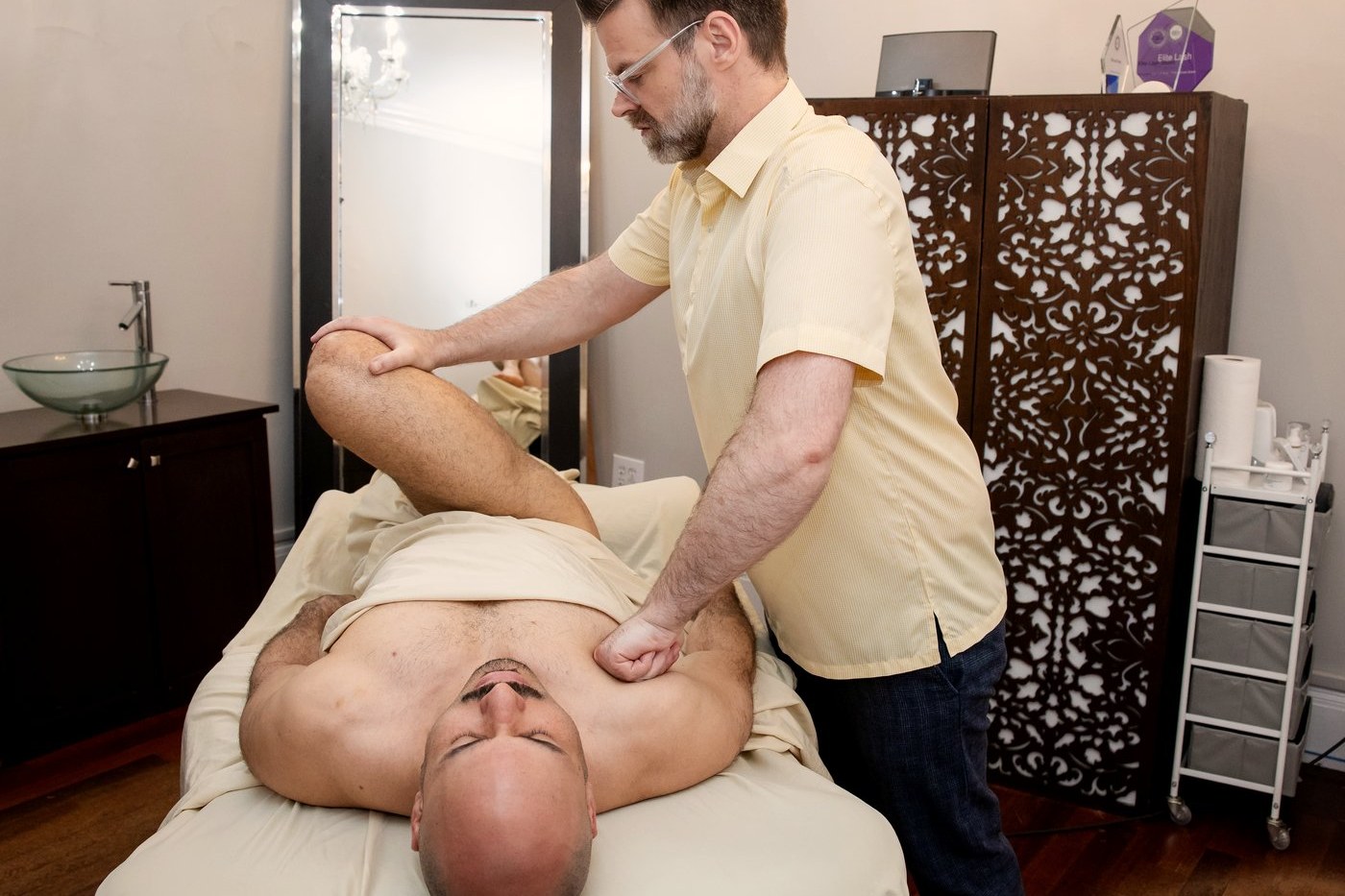
In my practice, the approach has two parts. First, I identify exactly where the nerve is being compressed and release the specific muscles creating the problem. That means hands-on work on the structures involved—targeted pressure on the piriformis, the deep hip rotators, the deep low back, the muscles along your spine, whatever is creating the compression in your body specifically. It’s diagnostic bodywork aimed at the specific structures creating the compression.
Second — and this is the part that determines whether the relief lasts — we address why those muscles were tight in the first place. That usually means waking up the glutes and gluteus medius through specific strengthening work you do between sessions. Glute bridges, clamshells, single-leg work, banded walks. None of it is exotic. What matters is that you do it consistently, because the posterior chain doesn’t rebuild from a two-week program. It responds to a permanent change in how you use your body. Page, Frank, and Lardner (2010) lay out the full Janda-approach progressions in detail.
Most clients with sciatica notice a meaningful shift within the first two or three sessions. The pain changes. It moves, or it eases, or the worst of the shooting stops. That’s the compression releasing. The longer-term work is keeping it released, and that’s where the glute strengthening and regular maintenance sessions do the heavy lifting.
When to come in — and when to see your doctor first
You don’t have to wait for the pain to be at its worst to start this work. But if you’re in an acute flare, that’s fine too. The approach shifts to gentler, more neurological work that calms the guarding muscles without provoking the nerve. Either way, we can usually start making progress from the first session.
There are a few situations where you should see your doctor before booking with me: new numbness or tingling that’s spreading, any loss of bladder or bowel control, or leg weakness that’s getting rapidly worse. Those are signs of something that needs medical evaluation first. Short of that, soft tissue work is safe and usually the fastest path to relief.
Related: Sciatica treatment — how I work with it · Piriformis syndrome · The posterior chain problem
References & Further Reading
- Beaton LE, Anson BJ. (1937). The relation of the sciatic nerve and of its subdivisions to the piriformis muscle. Anatomical Record, 70(1): 1–5.
- Smoll NR. (2010). Variations of the piriformis and sciatic nerve with clinical consequence: a review. Clinical Anatomy, 23(1): 8–17.
- Travell JG, Simons DG. (1992). Myofascial Pain and Dysfunction: The Trigger Point Manual. Volume 2: The Lower Extremities. Baltimore: Williams & Wilkins.
- Reiman MP, Bolgla LA, Loudon JK. (2012). A literature review of studies evaluating gluteus maximus and gluteus medius activation during rehabilitation exercises. Physiotherapy Theory and Practice, 28(4): 257–268.
- Tonley JC, Yun SM, Kochevar RJ, Dye JA, Schroeder S, Tillman MD. (2010). Treatment of an individual with piriformis syndrome focusing on hip muscle strengthening and movement reeducation: a case report. Journal of Orthopaedic & Sports Physical Therapy, 40(2): 103–111.
- Janda V. (1987b). Muscle weakness and inhibition (pseudoparesis) in back pain syndromes. In: Grieve GP, ed. Modern Manual Therapy of the Vertebral Column. Edinburgh: Churchill Livingstone.
- Page P, Frank C, Lardner R. (2010). Assessment and Treatment of Muscular Imbalance: The Janda Approach. Champaign, IL: Human Kinetics.