If you’re reading this, your jaw probably hurts — and there’s a decent chance a night guard is sitting on your nightstand that still isn’t settling it. Maybe a dentist fitted you for one. Maybe the whole thing started the week you got Invisalign and your bite shifted overnight. Or maybe there’s no injury and no long history at all — just a run of hard, stressful weeks, and somewhere in there your jaw quietly became the place all of it collected. It clenches while you sleep. It aches by mid-afternoon. It’s started pulling at your temples, your ears, the side of your neck.
Some of the people who find me have already been down the road — a dentist, sometimes a doctor, a guard, a retainer — and they’re still waking up with a locked jaw. Others haven’t started any of that yet and would rather try something hands-on first. Both doors lead to the same room. You don’t have to have exhausted every option to come see me, and you don’t have to keep waiting if you already have.
The guard protects your teeth. It was never built for the muscle.
A night guard does a real job, and does it well: it keeps you from grinding your teeth down while you sleep. That’s worth having. But protecting the teeth and releasing the muscle are two different problems. The guard sits between your teeth — it doesn’t reach the masseter at the corner of your jaw or the temporalis at your temple, the muscles that are actually doing the clenching. You can wear a guard faithfully every night for years and still wake with your jaw set like a fist, because the tension itself never got worked.
The one place the medical route does reach that muscle directly is Botox, which quiets the clench by weakening the muscle for a few months. Hands-on work takes the opposite road. Instead of switching the muscle off, it releases the tension the muscle is holding and leaves it free to keep doing its job — chewing, talking, yawning — without the ache. That release is the piece that so often goes unaddressed.
You don’t have to wait until nothing’s left to try
I’d rather see someone early — before jaw pain has turned into a year-long project. If you’ve only just noticed it, if the Invisalign or the stress or the nighttime clenching is new, that’s a good time to come in, not a premature one. And if you’ve already been through the dentist, the guard, and a specialist and you’re still hurting, that isn’t you failing at getting better. It usually just means the muscular side of this never got hands on it.
Most jaw pain is muscular, and for muscular tension, bodywork is a reasonable first thing to try — not only a last resort. It’s also a reasonable thing to add when the rest hasn’t gotten you there. (If your jaw pain is severe, worsening fast, or comes with other symptoms, it’s sensible to get it looked at, too. This isn’t either/or.)
How I actually work
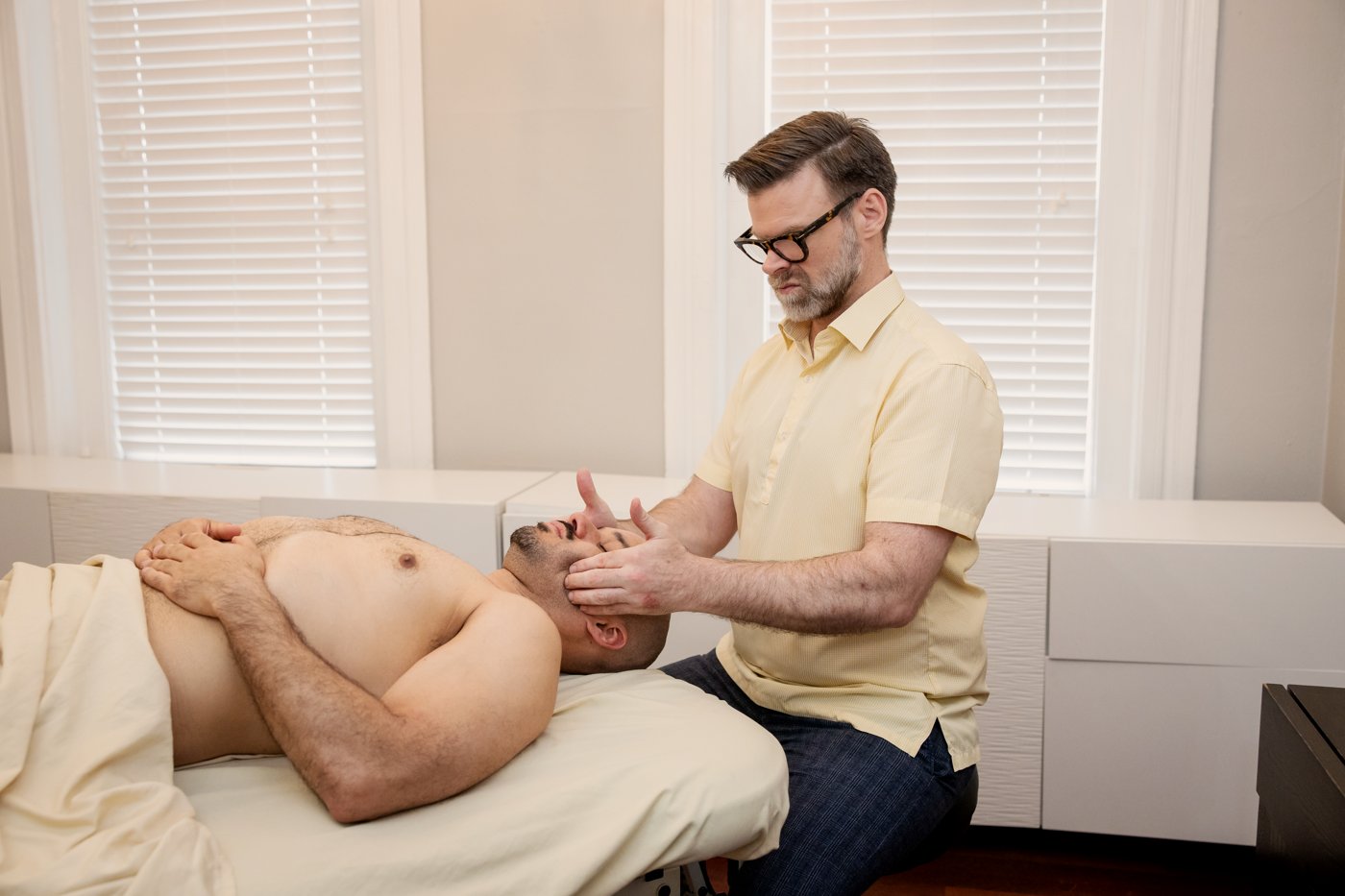
Here’s what a session with me is, start to finish. I listen to you. I believe you — you don’t have to convince me your pain is real before we begin. Then I challenge you a little, I get to work, and I bring every tool twenty years of doing this has given me. I don’t treat the jaw as an island. I work the whole system it lives in: the jaw muscles themselves, yes, but also the neck, the shoulders, and the upper back that keep feeding tension into it. When the jaw is the only thing getting attention, that’s usually why the relief doesn’t last.
I’ll be straight with you about one thing: this work can be intense. Muscles that have been braced for months don’t let go gently. My clients tend to describe it as tough — and then, almost in the same breath, as worth it. I don’t have to take my own word for that. Here’s how a few of them have put it.
“The massages are incredibly intense but extremely effective and I leave feeling like a new woman.”
— L.A., on treatment for severe TMJ and neck issues
“I came to John … with new ailments (TMJ and shoulder pain) — as always he was tough but effective.”
— Cheri M.
The words that stay with me
Every so often a client says the thing I could never quite say about my own work, because it means more coming from them. One person had been chasing jaw pain for years — through more than one kind of care — before we started working together. Afterward, this is how they described it:
“I sought treatment for TMJ pain for years, and this is the first time I really feel that the root cause of it was addressed.”
— M.G.
That’s the whole aim — not to quiet a jaw for an afternoon, but to find what’s driving the clench and change it. If your jaw has been running your day, whether you’ve tried everything or you’re only starting to look, come in and let’s get to work.
References & Further Reading
- Calixtre LB, Moreira RFC, Franchini GH, Alburquerque-Sendín F, Oliveira AB. (2015). Manual therapy for the management of pain and limited range of motion in subjects with signs and symptoms of temporomandibular disorder: A systematic review of randomised controlled trials. Journal of Oral Rehabilitation, 42(11): 847–861.
- Okeson JP. (2013). Management of Temporomandibular Disorders and Occlusion, 7th ed. St. Louis: Mosby/Elsevier.