You crossed the finish line. Maybe you hit your time, maybe you didn’t, maybe you stopped caring about the time somewhere around Heartbreak Hill and just ran. Either way, you did it. Twenty-six point two miles from Hopkinton to Boylston Street, and now you’re here — sitting down for the first time in hours, wondering why your quads feel like concrete and your feet feel like someone else’s.
What happens next matters more than most runners realize.
The First 72 Hours
Right now, your body is running an enormous repair operation. Your muscles are dealing with thousands of micro-tears. That’s normal, that’s how tissue rebuilds stronger. Your inflammatory response is doing exactly what it’s supposed to do. The soreness, the stiffness, the strange feeling in your calves when you try to walk downstairs — all of that is your body doing its job.
This is not the time for deep tissue work. I know that sounds counterintuitive coming from someone who does deep tissue work for a living, but the truth matters more than the booking. In the first 48–72 hours after a marathon, your tissue is actively inflamed. Heavy pressure now would be working against your body’s own recovery process, not with it.
Walk. Hydrate more than you think you need to. Eat real food. Sleep as much as your body asks for. If you’re a runner who trains seriously, you already know this part. Trust it.
Days 3–7: When the Real Work Starts
This is when most runners hit the wall they weren’t expecting. The acute soreness fades, so you think you’re fine. But your hips, low back, and shoulders are still holding compensations from the race. Your IT bands are tight in ways that stretching alone won’t reach. Your calves and feet may feel functional, but the tissue is still reorganizing. The trigger-point patterns laid down in the lower-extremity muscles during the back half of a long race tend to consolidate in this window if nothing addresses them (Travell & Simons, 1992).
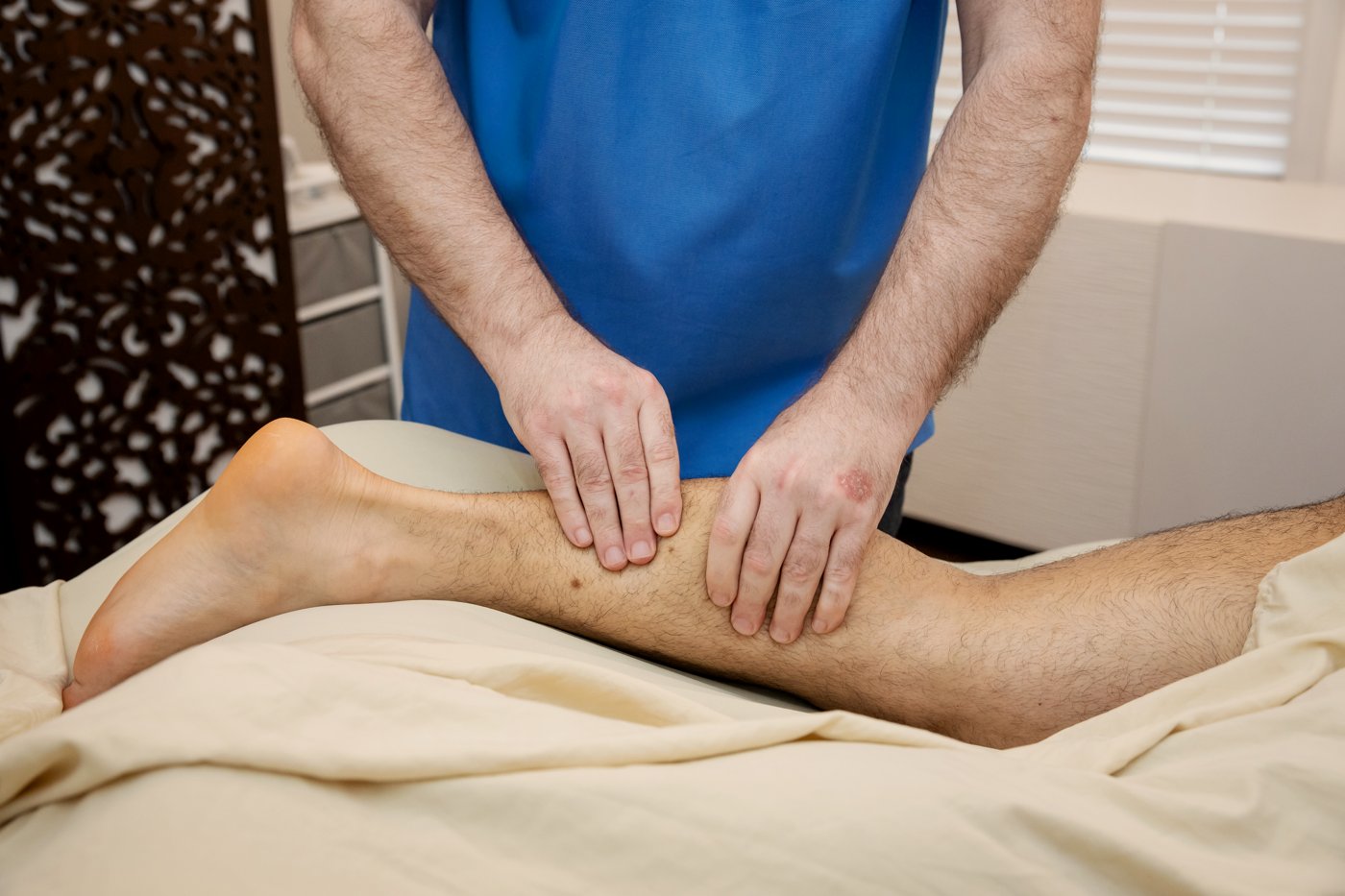
This is when targeted bodywork makes the biggest difference — work from someone who understands what 26.2 miles does to tissue, who can feel where your gait compensated, where your hip hiked, where your shoulders climbed because your legs were done and your upper body tried to take over. Hip-hiking under fatigue is the classic sign of gluteus medius giving out late in a race (Reiman et al., 2012); once you can see it, you can work it.
I’ve worked with runners after every Boston Marathon for two decades. The patterns are remarkably consistent. The details are completely individual.
What I’m Looking For
When a runner comes in after a marathon, I’m not just chasing soreness. I’m reading the story the race left in their body. The quads and calves get all the attention, but the real restrictions usually live in the hip flexors, the deep hip rotators, the tissue around the piriformis and SI joint. The places that had to stabilize for four hours while everything else was moving. When the glute medius and maximus fatigue, the piriformis picks up the slack, which is why so many runners come off long efforts with sciatic-pattern symptoms (Tonley et al., 2010).
I’m also checking what the race revealed. A marathon doesn’t create problems. It exposes them. That knee thing you’ve been ignoring since February? The low back tightness that shows up at mile 18? Those are patterns that existed before the starting gun. The marathon just made them loud enough to hear. Most of these compensations sit on top of what Janda (1987b) called lower crossed syndrome — tight hip flexors and lumbar erectors paired with inhibited glutes and deep abdominals (Page, Frank & Lardner, 2010).
When to Book
The ideal window for your first post-marathon session is 4–7 days after the race. For Boston 2026, that puts you somewhere between April 24 and April 27. That gives the acute inflammation time to settle while the compensatory patterns are still fresh enough to address.
A second session 10–14 days out helps catch anything that surfaced once you started running again. Most runners who take recovery seriously book both.
Marathon Week 2026
If you’re racing on April 20th, I have a few things set up for you this year. I still have spots open on Sunday, April 19 — a pre-race tune-up the day before to loosen what needs loosening without taking anything away from your legs. Light, targeted, nothing aggressive.
On Marathon Monday, I’m running special evening hours from 5–10 PM. That window is built for the runners who finish and want to get on the table same-day. This isn’t deep tissue work. It’s circulation-focused recovery: flushing the legs, calming the nervous system, and giving your body a head start on what’s coming over the next week. A handful of spots are still open.
If you’re coming from out of town for the race, the timing still works. My practice is in Back Bay, a short walk from the finish line. And if you’re local and this is your year to finally address that thing that always shows up at mile 18, we should talk.
Your body just carried you 26.2 miles through one of the greatest courses in the world. It deserves someone who knows how to help it recover.
Related: Sports injury recovery · Posterior chain imbalance · Piriformis syndrome · Runner’s knee · Plantar fasciitis
References & Further Reading
- Travell JG, Simons DG. (1992). Myofascial Pain and Dysfunction: The Trigger Point Manual. Volume 2: The Lower Extremities. Baltimore: Williams & Wilkins.
- Reiman MP, Bolgla LA, Loudon JK. (2012). A literature review of studies evaluating gluteus maximus and gluteus medius activation during rehabilitation exercises. Physiotherapy Theory and Practice, 28(4): 257–268.
- Tonley JC, Yun SM, Kochevar RJ, Dye JA, Schroeder S, Tillman MD. (2010). Treatment of an individual with piriformis syndrome focusing on hip muscle strengthening and movement reeducation: a case report. Journal of Orthopaedic & Sports Physical Therapy, 40(2): 103–111.
- Janda V. (1987b). Muscle weakness and inhibition (pseudoparesis) in back pain syndromes. In: Grieve GP, ed. Modern Manual Therapy of the Vertebral Column. Edinburgh: Churchill Livingstone.
- Page P, Frank C, Lardner R. (2010). Assessment and Treatment of Muscular Imbalance: The Janda Approach. Champaign, IL: Human Kinetics.